


Pedro Vargas1; Valéria Barreto Campos2; Flávia Pereira Reginatto3; Christine Chaves Prato1; Célia Luiza Petersen Vitello Kalil3
Funding: None
Conflict of interest: None
Submitted on: 11/18/2025
Final decision: 02/01/2026
How to cite this article: Vargas P, Campos VB, Reginatto FP, Prato CC, Kalil CLPV. Clean beauty: definitions, distinctions among natural, organic, and vegan cosmetics, and experimental evidence on endocrine disruptors in cosmetics. Surg Cosmet Dermatol. 2026;18(1):e20260540.
In recent years, the demand for eco-friendly cosmetics formulated with safer and more sustainable ingredients has driven the expansion of the global market. The concept of clean beauty has evolved into a philosophy that requires transparency, safety, and sustainability throughout the production chain. This review article updates the definitions of clean beauty, differentiates natural, organic, and vegan cosmetics, and details experimental findings on endocrine disruptors present in cosmetic formulations, including in vitro and in vivo evidence.
Keywords: Cosmetics; Coloring Agents; Aquatic Environment; Allergens
The demand for skincare routines using natural products free of controversial ingredients has become a well-established trend and continues to drive global sales.1–3 The global market for natural cosmetics is projected to grow at an annual rate of 6.75% between 2024 and 2028, reaching USD 18.01 billion.3 Brazil remains the fourth largest beauty market worldwide, generating BRL 173.4 billion in 2024, with a growth rate of 10.3% and projections to reach USD 40 billion by 2027.4 Clean beauty products are expected to outpace the traditional cosmetics industry, with an average annual growth of 12%.2
This study is a narrative literature review based on the critical analysis of relevant scientific publications addressing the concept of clean beauty, distinctions among natural, organic, and vegan cosmetics, and experimental evidence related to endocrine disruptors (EDs) in cosmetic products. Databases including PubMed, Scopus, and Google Scholar were searched, prioritizing experimental studies, narrative reviews, and regulatory documents.
Associated with clean beauty, the minimalist skincare approach emphasizes simplified routines, avoiding excessive active ingredients while prioritizing skin barrier health.2 This trend reflects a shift in consumer behavior toward more streamlined, safer formulations with a lower risk of sensitization.
Clean beauty refers to products that are considered safe, transparent, and free of controversial ingredients such as parabens, sulfates, phthalates, petrolatum, and synthetic fragrances.1,5 Although there is no universally accepted regulatory definition, the term is widely used to describe formulations developed under more conservative safety standards.
Natural cosmetics are primarily composed of raw materials derived from animal, plant, or mineral sources, provided they are minimally processed. The maximum allowable percentage of synthetic ingredients varies across certification bodies but generally does not exceed 5% and is restricted to substances considered low risk.5
Organic cosmetics are derived from raw materials cultivated without synthetic pesticides and fertilizers, using crop rotation and biological pest control methods. Certification requires ≥ 95% organic ingredients. An example of organic certification in cosmetics is Ecocert, internationally recognized for ensuring that products are formulated with natural and organically sourced ingredients. This certification guarantees the absence of synthetic components, such as parabens, silicones, and artificial fragrances, and requires that production processes adhere to environmental sustainability, animal welfare, and sustainable practices, including eco-friendly packaging.5
Vegan cosmetics align with the cruelty-free philosophy, meaning they do not contain ingredients of animal origin and are not tested on animals at any stage of production. Vegan products may be synthetic and are not necessarily natural or organic.5 Importantly, the term "vegan" refers exclusively to the origin of ingredients and does not inherently imply lower toxicological risk or greater sustainability.
The Brazilian Health Regulatory Agency (Anvisa) does not yet provide formal definitions for "natural," "organic," or "vegan." As a result, these definitions remain under the purview of private certification bodies and international standards.6 Recent regulatory updates — Normative Instruction No. 280/2024 and Collegiate Board Resolutions No. 951/2024 and No. 894/2024 — have brought light to substance lists, risk classification, mandatory labeling in Portuguese, and the reporting of serious adverse events, including suspected endocrine disruption.6
A bill currently under consideration proposes the inclusion of warning labels addressing the risk of endocrine disruption in cosmetic products.6 Despite advances, Brazil still lacks unified and specific regulatory criteria for natural, organic, or vegan formulations.
In the United States, cosmetics are regulated by the Food and Drug Administration (FDA) under the Federal Food, Drug, and Cosmetic Act (FD&C Act), which historically did not require premarket approval for most cosmetic ingredients, except for color additives. With the enactment of the Modernization of Cosmetics Regulation Act of 2022 (MoCRA), the FDA's authority has been expanded to include mandatory facility registration, product listing, reporting of serious adverse events, scientific substantiation of ingredient safety, and the ability to mandate product recalls.7,8
In the European Union (EU), regulation — coordinated by the European Medicines Agency (EMA) — is more stringent and is governed by Regulation (EC) No. 1223/2009. This regulation determines that the safety of any cosmetic product must be proven prior to marketing. It constitutes the primary legal framework governing cosmetic products marketed in the EU, establishing strict safety requirements to ensure a high level of protection of human health and the free movement of cosmetic products in the internal market. The European Commission (executive arm of the EU) maintains a priority list of substances under evaluation for their potential endocrine-disrupting properties and applies harmonized criteria for their restriction based on the precautionary principle.6,9
EDs are chemical substances capable of interfering with the synthesis, transport, metabolism, and action of endogenous hormones, even at low concentrations.10,11 These effects may occur through multiple mechanisms, including hormone mimicry, receptor blockade, enzymatic changes, and modulation of nuclear signaling pathways. Examples of EDs in cosmetics include:
Parabens (methyl-, propyl-, butylparaben): weak estrogenic activity and potential risk of breast carcinogenesis10;
Phthalates: antiandrogenic effects and disruption of steroidogenesis11;
Chemical UV filters (benzophenone-3, octocrylene): bioaccumulation and toxicity12,13;
Butylated hydroxytoluene (BHT): antioxidant associated with aquatic toxicity14;
Triclosan and bisphenol A (BPA — a chemical widely used in plastics and resins and associated with health concerns): modulation of hormone receptors and adverse metabolic effects.15
EDs may affect multiple systems:
Female reproductive system: precocious puberty, polycystic ovary syndrome (PCOS), endometriosis, and menstrual irregularities10;
Male reproductive system: reduced sperm count and motility, infertility, and risk of testicular cancer11,15;
Metabolic system: obesogenic effects, insulin resistance, and transgenerational inheritance of obesity15;
EDs may also affect vulnerable populations, such as pregnant and lactating individuals, as well as those with chronic conditions, including malignancies.16 Increased susceptibility in these groups results from physiological changes, higher rates of skin absorption, or exacerbated systemic effects.
Parabens: Increased proliferation of MCF-7 cells, a human breast cancer cell line originally developed at the Michigan Cancer Foundation (now the Barbara Ann Karmanos Cancer Institute, Detroit, USA). This cell line, derived from an adenocarcinoma, is widely used in research as a model of hormone (estrogen and progesterone) receptor-positive breast cancer and demonstrates activation of estrogen-responsive elements.10
Phthalates: Reduced testosterone production and changes in steroidogenic enzymes.12
Chemical UV filters: Estrogenic/antiandrogenic activity and changes in thyroid gene expression.12,13
Triclosan and BPA: Modulation of nuclear receptors and hormonal signaling pathways.15
Parabens: Hormonal alterations in pregnant rodents and breast tissue.10
Phthalates: Antiandrogenic effects and genital malformations in fetuses.11
UV filters: Bioaccumulation and transgenerational effects in fish and vertebrates.12,13
Triclosan and BPA: Reproductive and metabolic dysfunctions in animal models.15
The consistency of these findings supports the biological plausibility of adverse effects associated with chronic exposure; however, extrapolation to humans requires caution.
In recent years, concern has also emerged regarding the accumulation of mineral oil saturated hydrocarbons (MOSH) and mineral oil aromatic hydrocarbons (MOAH) in cosmetic products, particularly lipsticks, creams, and lip products that may be inadvertently ingested. These compounds, derived from incompletely refined mineral oils, can bioaccumulate in human tissues and induce chronic inflammatory responses, such as MOSH syndrome, characterized by the formation of hepatic and splenic microgranulomas in both animal and human studies.18, Autores: a lista de referências termina na ref 18, favor verificar a que se refere esta citação de número.
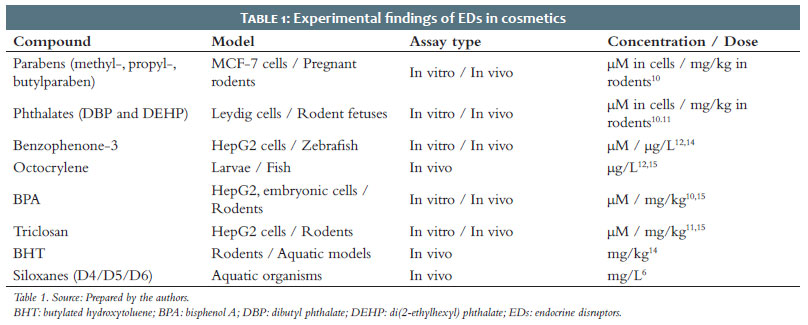
Studies indicate that some cosmetic products contain elevated levels (>5%) of MOSH and polyolefin oligomeric saturated hydrocarbons (POSH), which are derived from plastics such as polyethylene and polypropylene (polyolefins) and are often associated with migration from packaging materials. Chronic exposure to these compounds may be associated with endocrine disruption and hepatotoxic effects.17 Table 1 summarizes the main in vitro and in vivo experimental findings related to EDs in cosmetics, including study models, assay types, and concentration ranges evaluated.
The EU considers the presence of MOAH, particularly those containing 3 or more aromatic rings, a potential concern due to their possible genotoxic and carcinogenic properties. Therefore, regulatory authorities recommend their substitution with highly refined raw materials and continuous monitoring of residual contamination.18
International regulatory agencies have intensified surveillance of MOSH/MOAH in cosmetics; however, a global consensus has yet to be established.
The clean beauty movement has emerged as a new paradigm in the cosmeceutical industry, integrating safety, transparency, and sustainability as essential pillars. A clear distinction among natural, organic, and vegan cosmetics is critical to avoid misinterpretation and to ensure that consumers and professionals — especially dermatologists — understand the true scope and limitations of each category, beyond the marketing appeal often associated with the topic.
Concurrently, a growing body of scientific evidence indicates that several EDs present in cosmetic formulations may interfere with hormonal systems through multiple mechanisms, as demonstrated in both in vitro and in vivo studies. These findings highlight the clinical relevance of the topic and the need for continuous surveillance regarding cumulative exposure to these compounds.
More robust regulatory policies are essential to establish exposure limits, standardized evaluation criteria, and specific guidelines for substances of concern. In this context, coordinated efforts involving regulatory advancements, toxicological surveillance, and educational strategies directed at health care professionals, researchers, industry stakeholders, and consumers are necessary. Only through such an integrated approach will it be possible to promote safer cosmetic practices aligned with the principles of clean beauty, while safeguarding both human health and environmental integrity.
This review has limitations inherent in its design, including the absence of systematic search criteria and formal assessment of the methodological quality of the included studies. In addition, much of the available evidence on EDs in cosmetics is derived from in vitro studies and animal models, which requires caution when extrapolating findings directly to clinical practice in humans. The heterogeneity of experimental models, substances evaluated, doses employed, and outcomes assessed also limits direct comparisons across studies. Nevertheless, the compiled data provide consistent biological plausibility and reinforce the relevance of the topic, highlighting the need for well-designed clinical studies and continued monitoring of exposure to these compounds.
Pedro Vargas
ORCID: 0000-0002-5376-2696
Approval of the final version of the manuscript, Preparation and writing of the manuscript, Acquisition, analysis and interpretation of data, Effective participation in the conduct of the study, Intellectual participation in the propaedeutic and/or therapeutic approach to the cases studied, Critical review of the literature, Critical revision of the manuscript.
Valéria Barreto Campos
ORCID: 0000-0002-3350-8586
Approval of the final version of the manuscript, Effective participation in the conduct of the study, Critical revision of the manuscript.
Flávia Pereira Reginatto
ORCID: 0000-0002-8189-2375
Approval of the final version of the manuscript, Effective participation in the conduct of the study.
Christine Chaves Prato
ORCID: 0000-0001-8861-6499
Approval of the final version of the manuscript, Effective participation in the conduct of the study, Critical review of the literature, Critical revision of the manuscript.
Célia Luiza Petersen Vitello Kalil
ORCID: 0000-0002-1294-547X
Approval of the final version of the manuscript, Acquisition, analysis and interpretation of data, Effective participation in the conduct of the study, Intellectual participation in the propaedeutic and/or therapeutic approach to the cases studied, Critical review of the literature, Critical revision of the manuscript.
1. Kalil CLPV, Vargas AS, Grazziotin FPR, Campos VB, Chaves CRP. Clean beauty -literature review of new trends in cosmetics. Surg Cosmet Dermatol. 2022;14:e20220137.
2. Rubin CB, Brod B. Natural does not mean safe: the dirt on clean beauty products. JAMA Dermatol. 2019;155(12):1344–5.
3. All Sensez. Mercado global de cosméticos naturais deve crescer com uma taxa anual de 6,75% entre 2024 e 2028 [Internet]. 2024 Jul 18 [cited 2024 Oct 21]. Available from: https://www.allsensez.com.br/post/mercado-global-de-cosm%C3%A9ticos-naturais-deve-crescer-com-uma-taxa-anual-de-6-75-entre-2024-e-2028
4. ABRE. Mercado brasileiro de higiene e beleza movimenta R$ 173,4 bilhões em 2024 [Internet]. 2025 May 26 [cited 2024 Oct 21]. Available from: https://www.abre.org.br/inovacao/comunicacao/mercado-brasileiro-de-higiene-e-beleza-movimenta-r-1734-bilhoes-em-2024
5. Chagas NAL, Silva EC. Cosméticos naturais, orgânicos e veganos: uma tendência de mercado. Brasília: Universidade de Brasília; 2024. Available from: https://bdm.unb.br/handle/10483/38642
6. Kalofiri P, Biskanaki F, Kefala V, Tertipi N, Sfyri E, Rallis E. Endocrine disruptors in cosmetic products and the regulatory framework: public health implications. Cosmetics. 2023;10(6):160.
7. Vieira D, Duarte J, Vieira P, Gonçalves MBS, Figueiras A, Lohani A, et al. Regulation and safety of cosmetics: pre- and post-market considerations for adverse events and environmental impacts. Cosmetics. 2024;11(6):184.
8. Wells N. FDA regulation of cosmetics and personal care products under the Modernization of Cosmetics Regulation Act of 2022 (MoCRA). Congr Res Serv Rep. 2023;NA:NA.
9. European Commission. Regulation (EC) No 1223/2009 of the European Parliament and of the Council on cosmetic products [Internet]. Brussels: Official Journal of the European Union; 2009 [cited 2024 Oct 21]. Available from: https://eur-lex.europa.eu/legal-content/EN/TXT/?uri=CELEX:32009R1223
10. Gruber GA. A influência dos disruptores endócrinos na saúde feminina. Res Soc Dev.2024;13(12):e37131247579.
11. Souza LDSR, Oliveira Neta AI, Gomes JS, et al. Cosméticos com presença de disruptores endócrinos e gestação: percepção de risco pelos profissionais de saúde. Rev Rene. 2024;25:377.
12. Carve M, Nugegoda D, Allinson G, Shimeta J. A systematic review and ecological risk assessment for organic ultraviolet filters in aquatic environments. Environ Pollut. 2021;268:115894.
13. Pinasseau L, Wiest L, Fildier A, Volatier L, Fones GR, Mills GA, et al. Passive sampling and high-resolution mass spectrometry using suspect screening to characterise emerging pollutants in contaminated groundwater and runoff. Sci Total Environ. 2019;672:253–63.
14. Costa FG. Avaliação da toxicidade dos subprodutos de degradação por cloração do filtro solar benzofenona-3. 2025.
15. Huang Y, Law JCF, Lam TK, Leung KSY. Risks of organic UV filters: a review of environmental and human health concern studies. Sci Total Environ. 2021;755:142486.
16. Bikiaris N, Nikolaidis NF, Barmpalexis P. Microplastics in cosmetics: a review on their presence in PCCPs and sustainable alternatives from biobased and biodegradable polymers. Cosmetics. 2024;11(5):145.
17. Martínez-Rodríguez Y, Acosta-Muñiz C, Olivas GI, Guerrero-Beltrán J, Rodrigo- Aliaga D, Sepúlveda DR. High hydrostatic pressure processing of cheese. Compr Rev Food Sci Food Saf. 2012;11(4):399–416.
18. EFSA Panel on Contaminants in the Food Chain (CONTAM). Scientific opinion on mineral oil hydrocarbons in food. EFSA J. 2012;10(6):2704.
 All content the journal, except where identified, under the Creative Commons Attribution 4.0 International licence - ISSN-e 1984-8773



 Read in Portuguese
 Portuguese PDF
 Print
Print
 Send this article by email
 How to cite this article
 Submit a comment
 Mendeley
 Pocket
 Share on Facebook
 Share on Twitter