


Shaimaa Farouk
Funding: None
Conflict of interest: None
Submitted on: 08/26/2025
Final decision: 10/09/2025
How to cite this article: Farouk S. Oral isotretinoin as a promising treatment for refractory molluscum contagiosum in a child: a case report. Surg Cosmet Dermatol. 2026;18(1):e20260510.
Molluscum contagiosum is a common viral infection in children, usually self-limiting, but treatment of extensive or recalcitrant cases can be challenging. We report a child with refractory MC unresponsive to conventional therapies who achieved complete clearance with low-dose oral isotretinoin. This case highlights the potential of isotretinoin as a novel therapeutic approach for refractory molluscum contagiosum in children.
Keywords: Molluscum contagiosum; Isotretinoin; Child; Retinoids
Molluscum contagiosum (MC) is a benign viral skin infection caused by a poxvirus, predominantly affecting children. Although it typically resolves spontaneously within 6–18 months, some patients develop extensive, persistent lesions that are resistant to conventional treatments such as cryotherapy, curettage, and topical keratolytics.1 In such cases, management becomes challenging and may result in significant discomfort, secondary infections, and psychosocial distress.
Oral isotretinoin, a systemic retinoid primarily used for severe acne, has demonstrated beneficial effects in certain viral dermatoses, including recalcitrant warts and MC, due to its immunomodulatory, antiproliferative, and keratinocyte-differentiating properties.2,3 Emerging reports suggest that isotretinoin may serve as a promising therapeutic modality in refractory MC, including in pediatric populations.4
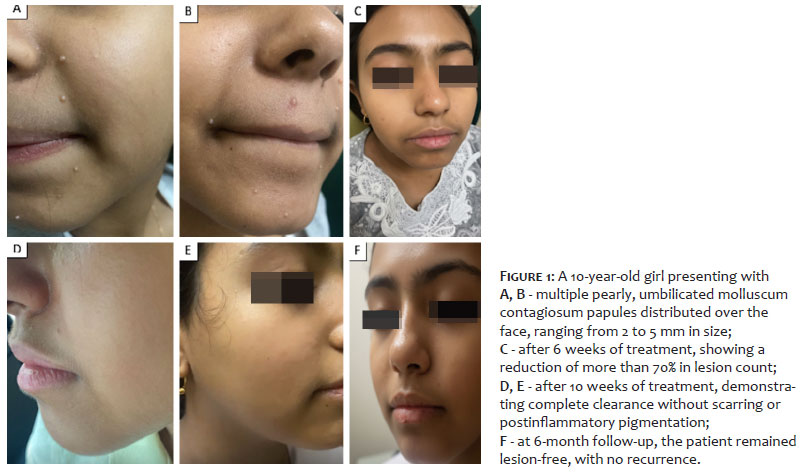
A 10-year-old girl presented with multiple pearly, umbilicated papules distributed across the face, trunk, axillae, and extremities for 14 months. The lesions had progressively increased in number despite several treatment modalities (Figure 1).
Previous therapies included cryotherapy, curettage, and topical keratolytics (salicylic acid), all with minimal improvement. Lesions recurred within weeks and became more widespread. The disease was associated with mild pruritus and occasional bacterial superinfection secondary to scratching.
On examination, more than 120 lesions were noted, ranging from 2 to 5 mm in size, with some showing erythematous or crusted surfaces. Routine hematologic and biochemical parameters, including complete blood count (CBC), liver function tests (ALT, AST), renal function tests, and fasting lipid profile, were within normal limits. HIV serology was negative, and there was no family history of immunodeficiency.
Given the refractory nature of the disease and its psychosocial burden, oral isotretinoin was initiated at 0.5 mg/kg/day after baseline laboratory evaluation. Laboratory monitoring was repeated every 4 weeks both during treatment and for 6 months after discontinuation, including CBC, liver enzymes, and lipid profile. All remained within normal ranges throughout therapy and follow-up. Treatment continued for 10 weeks, and isotretinoin was discontinued after complete resolution of the lesions.
The therapy was well tolerated, with only mild cheilitis reported. By 6 weeks, the lesion count had decreased by more than 70%, and complete clearance was achieved by week 10 without scarring or postinflammatory pigmentation. At 6-month follow-up after treatment discontinuation, the patient remained lesion-free, with normal laboratory findings.
Although MC is typically self-limiting, extensive or recalcitrant cases often require active treatment. Conventional destructive modalities, such as cryotherapy, curettage, and topical caustics, may be painful, cosmetically undesirable, and prone to recurrence.1 Alternative systemic options, including cimetidine and interferon, have demonstrated inconsistent efficacy.2
Isotretinoin exerts its effect through modulation of keratinocyte differentiation, inhibition of epidermal proliferation, and enhancement of cutaneous immune surveillance.3,5 Furthermore, isotretinoin downregulates epidermal growth factor receptor (EGFR) expression, which may reduce viral replication and propagation.5
Our findings are consistent with recent studies. Ramdan et al. reported a series of 20 children with refractory MC treated with isotretinoin (0.5 mg/kg/day), achieving significant improvement within a mean of 6.6 weeks, with only one recurrence at 3-month follow-up.4 Similarly, Paudel and Chudal documented rapid clearance of extensive molluscum lesions in an immunocompromised adult treated with isotretinoin, further supporting its potential role. The authors also discussed the potential role of isotretinoin in MC, particularly in immunosuppressed patients. Although an "antiviral role" has been hypothesized, current evidence favors an indirect mechanism rather than a direct antiviral effect. Isotretinoin primarily acts by normalizing keratinocyte differentiation, reducing epidermal proliferation, and altering follicular keratinization, thereby creating an unfavorable environment for viral replication and persistence. In addition, its immunomodulatory properties may enhance host defense mechanisms, contributing to lesion clearance. These combined effects likely explain the benefits observed in recalcitrant MC, although definitive mechanistic studies remain limited.6
In our case, low-dose isotretinoin proved effective and well tolerated, with only mild mucocutaneous dryness, consistent with previous reports.4,6 Sustained clearance at 6-month follow-up further supports a durable therapeutic benefit.
Oral isotretinoin, though effective, requires caution in pediatric patients under 12 years of age, as this represents an off-label indication. Adverse effects are dose-dependent and primarily include mucocutaneous dryness (cheilitis, xerosis), transient elevations in liver enzymes, and hyperlipidemia. Less often, headache, musculoskeletal discomfort,2,3 or mood changes, including depression and anxiety, have been reported during treatment; however, this association remains controversial and unconfirmed by large-scale analyses.7
In children, the safety profile appears similar to that in adolescents when low doses (≤0.5 mg/kg/day) are used with appropriate monitoring. Laboratory evaluations should include baseline and periodic assessment of hepatic function and lipid profile every 4– 6 weeks. Adequate hydration, use of emollients, and sun protection should be advised. Parental counseling regarding off-label use, potential adverse effects, and the need for regular laboratory monitoring is essential before initiation.
Oral isotretinoin represents a safe and promising therapeutic option for refractory MC in children when standard modalities fail. Its role as a systemic immunomodulator and regulator of keratinocyte biology supports its clinical efficacy. Larger randomized controlled trials are warranted to establish isotretinoin as a standard treatment for resistant pediatric MC.
Shaimaa Farouk
ORCID: 0009-0002-8704-3910
Statistical analysis, Approval of the final version of the manuscript, Conception and design of the study, Preparation and writing of the manuscript, Acquisition, analysis and interpretation of data, Effective participation in the conduct of the study, Intellectual participation in the propaedeutic and/or therapeutic approach to the cases studied, Critical review of the literature, Critical revision of the manuscript.
1. Chen X, Anstey AV, Bugert JJ. Molluscum contagiosum virus infection. Lancet Infect Dis. 2013;13(10):877-88.
2. Hebert AA, Bhatia N, Del Rosso JQ. Molluscum contagiosum: epidemiology, considerations, treatment options, and therapeutic gaps. J Clin Aesthet Dermatol. 2023;16(8 Suppl 1):S4-S11.
3. Layton A. The use of isotretinoin in acne. Dermatoendocrinol. 2009;1(3):162-9.
4. Ramdan R, Abou Alwafa H, Elgamal EE. Oral isotretinoin in the treatment of recalcitrant molluscum contagiosum in children. Int J Med Arts. 2021;3(3):1598-1601.
5. Rubin Grandis J, Zeng Q, Tweardy DJ. Retinoic acid normalizes the increased gene transcription rate of TGF-alpha and EGFR in head and neck cancer cell lines. Nat Med. 1996;2(2):237-40.
6. Paudel V, Chudal D. Oral isotretinoin therapy in recalcitrant molluscum contagiosum in an immunocompromised patient. Case Rep Dermatol Med. 2021;14:5529382.
7. Gradwohl K, Verghese M, Rosenblatt AE. Mood changes and clinical decision making in adolescent patients on isotretinoin therapy for acne vulgaris. Pediatr Dermatol. 2023;40(3):494-6.
 All content the journal, except where identified, under the Creative Commons Attribution 4.0 International licence - ISSN-e 1984-8773




 Read in Portuguese
 Portuguese PDF
 Print
Print
 Send this article by email
 How to cite this article
 Submit a comment
 Mendeley
 Pocket
 Share on Facebook
 Share on Twitter