


Helena Cargnelutti Grimaldi1; Sandro da Silva Camargo2
Funding: None
Conflict of interest: None
Submitted on: 07/07/2025
Final decision: 08/04/2025
How to cite this article: Grimaldi HC, Camargo SS. Mapping scientific contributions in surgical and cosmetic dermatology (2009-2024): Authors, institutions, and countries - Part I. Surg Cosmet Dermatol. 2025;17:e20250492.
INTRODUCTION: The journal Surgical & Cosmetic Dermatology (SCD), founded in 2009, has played a central role in disseminating scientific advances in dermatologic surgery, cosmetic dermatology, and related clinical practices in Brazil and Latin America. However, studies evaluating its scientific output from a bibliometric and scientific network perspective remain scarce.
OBJECTIVE: To map the principal authors, institutions, and topics covered by the journal, as well as its patterns of scientific collaboration.
METHODS: Over 1000 studies published since the inception of SCD were analyzed using data extracted from its digital archive. Bibliometric indicators and co-authorship networks were processed with specific data analysis and visualization tools.
RESULTS: The results identified the most productive and influential authors and highlighted consolidated institutional and international collaborations.
CONCLUSIONS: The findings demonstrate the evolution of the journal’s scientific scope and its relevance as an open-access platform for disseminating dermatological knowledge. This information may serve as a valuable resource for researchers, editors, and institutions interested in the editorial history and direction of SCD.
Keywords: Bibliometrics; Dermatological Surgical Procedures; Cosmetic Techniques; Collaboration Indicator
The journal Surgical & Cosmetic Dermatology (SCD), founded in 2009, has established itself as a key platform for disseminating scientific advances in dermatologic surgery, cosmetic procedures, and related clinical practices in Brazil and Latin America.1 With an emphasis on evidence-based innovations, the journal reflects emerging trends in minimally invasive techniques, cutaneous oncology, and aesthetic dermatology, serving both as a repository of clinical knowledge and as a tool for continuing professional development. Throughout its history, the journal has published a diverse body of work that mirrors the trajectory of Brazilian dermatology, particularly the expansion of cosmetic dermatology as a scientific and clinical field. However, although many studies have addressed specific interventions or therapeutic outcomes, few have examined the journal’s intellectual structure and thematic evolution from a macro-scientific perspective.
To address this gap, the present study applies scientometric methods and social network analysis (SNA) to examine the complete set of articles published in SCD since its inception. Similar approaches have been used to map institutional and thematic collaborations in various medical specialties. For example, international collaborations in neurosurgery have been analyzed through a social network analysis of the 50 most cited articles in the field.2 Scientometrics has also been discussed as a strategic instrument to analyze, quantify, and promote the presence of Brazilian dermatology in the international scientific arena.3 Scientometric studies have been conducted in the field of robotic surgery in different contexts.4,5 Social network analysis has likewise been used to identify patterns of international collaboration in emergency department publications in a single country.6 Finally, a historical and bibliometric analysis of the authors who contributed to Anais Brasileiros de Dermatologia (ABD) over its hundred-year history identified the most productive authors and their institutional affiliations.7
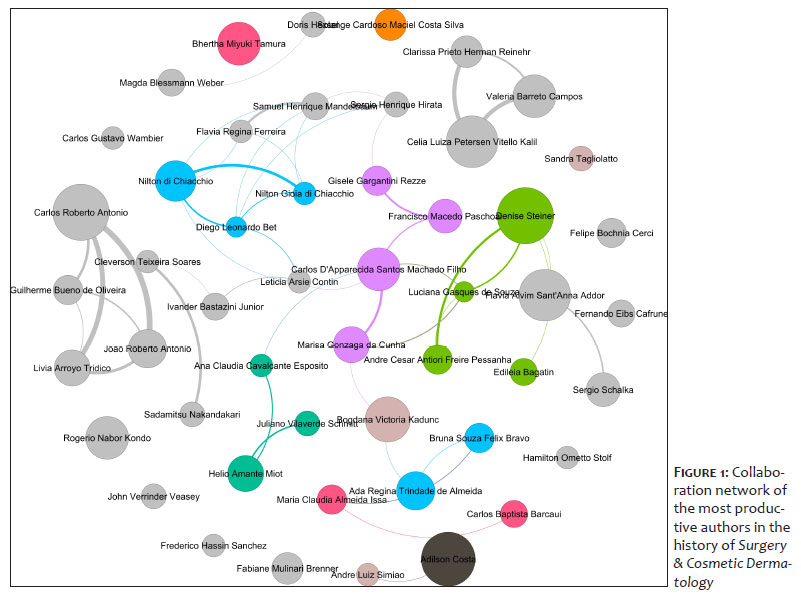
In this context, the present study seeks to identify the most prolific and influential authors in SCD history and to characterize the structure of institutional and international collaborations. These findings will contribute to a deeper understanding of the role of SCD in shaping dermatological knowledge and practice in Brazil, while highlighting the value of scientometric analysis in scientific communication in medicine (Figure 1).
The present study is applied in nature, with a quantitative approach and a descriptive purpose. It was conducted through documentary analysis, with data obtained directly from the SCD online portal. The following sections detail the methodological procedures adopted, covering data collection, database organization, construction of the co-authorship network, and calculation of bibliometric indicators.
The data was acquired by web scraping, a technique which enables the automated extraction of information from web pages.8 To that end, a scraper was developed and programmed to access and collect data from the issues available on the journal’s “Past issues” web page (http://www.surgicalcosmetic.org.br/previous-numbers). Data collection was performed on April 26, 2025, at 2:00 p.m., resulting in the full extraction of publicly accessible information at that time. Articles were compiled from volume 1, issue 1 (2009), through volume 16 (2024), covering 16 years of publication. The resulting database included the following metadata: article titles, author names, authors’ institutional affiliations, authors’ countries, year of publication, and keywords. At the end of the collection process, a total of 1,001 bibliographic records were identified, including original articles, review articles, case reports, clinical cases, letters to the editor, editorials, and the “How do I do it?” section.
After data collection, the records underwent preprocessing aimed at extracting and standardizing author names. Initially, 3945 unique names were identified; however, the presence of duplicates and spelling variations led to the use of the Levenshtein distance algorithm to compare nominal records.9,10 The procedure found inconsistencies such as: “Célia Kalil,” “Celia Luiza Kalil,” “Célia Luiza Petersen Vitelo Kalil,” “Celia Luiza Petersen Vitello Kalil,” and “Célia Luiza Petersen Vitello Kalil,” all corresponding to a single author. After name normalization, the total number of unique authors fell to 2384. Similar standardization strategies have been applied in previous bibliometric studies.7
The co-authorship network was modeled and analyzed using the Gephi software ( https://gephi.org/ ), based on concepts from graph theory, a pillar of social network analysis that has been applied countless times in the medical field.11,12 In the graph constructed for this study, the nodes represent authors, the edges indicate collaborations within the same article, and the edge weights indicate the number of collaborations between pairs of authors. The graph is undirected, as order of authorship was not taken into consideration.
• Publication count (Pub): total number of publications an author has participated in, regardless of authorship position.
• Degree: number of unique coauthors with whom an author has collaborated. High-degree authors tend to play a central role in a journal’s collaborative structure.13
• Betweenness Centrality (BC): measures an author’s capacity to act as a link between different research groups.14
• PageRank (PR): metric derived from the Google algorithm used to rank web pages in a query, here used to identify authors with leadership roles in the SCD network.15
• Community (Com): determined by the Louvain algorithm, which groups authors as a function of the density of connections.16 Communities were numbered according to size, with Community 1 being the largest.
After the authors were analyzed, the same approach was applied to institutional affiliations and countries.
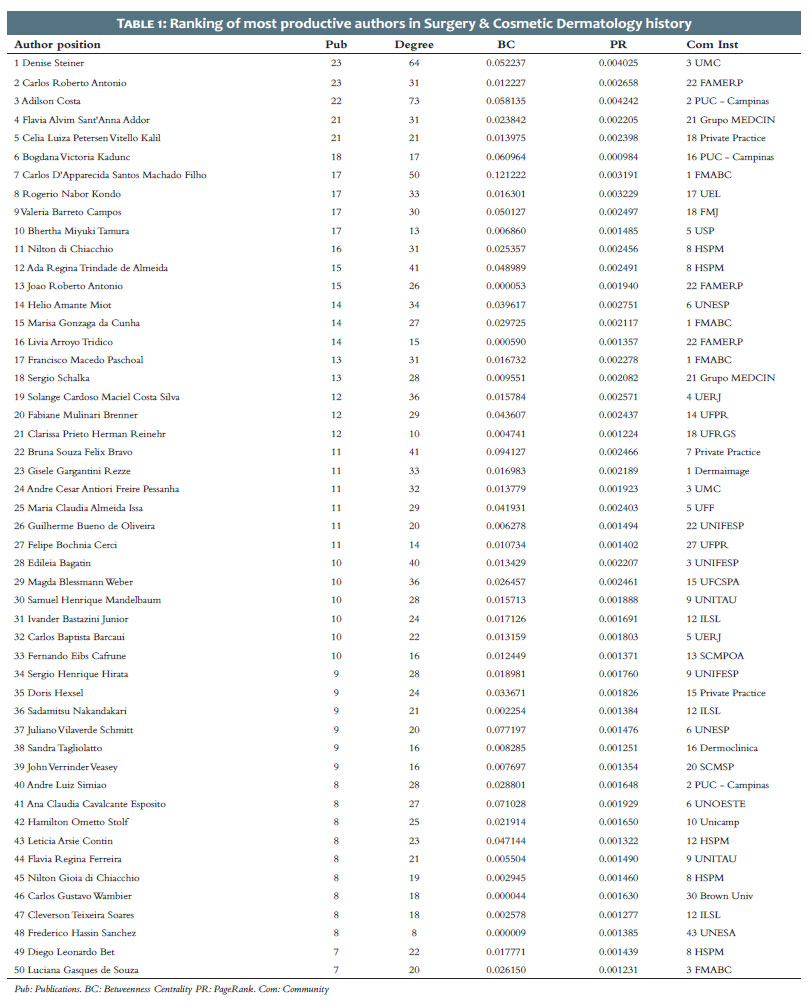
Table 1 lists the 50 most prolific SCD authors, accompanied by their respective bibliometric metrics. Authors are listed in descending order based on number of publications, degree of connectivity, betweenness centrality, and PageRank. In addition, the community of collaboration to which each author belongs is indicated, based on cluster detection in the co-authorship network, as well as the author’s institutional affiliation. To facilitate the identification of the most relevant researchers, the three highest values for each metric were highlighted in bold.
With respect to publication counts over the 16 years of SCD, authors Denise Steiner (Position 1) and Carlos Roberto Antonio (Position 2) stand out, both with 23 publications, followed by Adilson Costa (Position 3), with 22. These results highlight the consistent contribution of these scholars to the development and consolidation of the journal and indicate their recurring and central participation in the subjects addressed by SCD.
Regarding degree of connectivity in the co-authorship network, a metric that expresses the number of unique collaborators with whom an author has published throughout the journal’s history, Adilson Costa (Position 3), with 73 coauthors; Denise Steiner (Position 1), with 64; and Carlos D’Apparecida Santos (Position 7), with 50, stand out. These values indicate not only broad collaborative involvement but also the relevance of these authors in establishing lasting academic ties. High-degree authors tend to occupy central positions in the network, acting as facilitators of interaction among different research clusters. This configuration supports thematic integration, the exchange of knowledge, and the consolidation of scientific communities.
With regard to Betweenness Centrality, the authors Carlos D’Apparecida Santos (Position 7), Bruna Souza Felix Bravo (Position 22), and Juliano Vilaverde Schmitt (Position 37) stand out. This metric reflects the ability of authors to intermediate information flows between different segments of the scientific community. High-betweenness centrality authors tend to act as bridges between subgroups that would otherwise be isolated or only poorly integrated, promoting the circulation of knowledge and strengthening the cohesion of the network. The presence of Bruna Souza Felix Bravo and Juliano Vilaverde Schmitt among the authors with the highest betweenness, despite their lower absolute productivity, shows that structural influence within the network does not depend solely on the number of publications, but also on the strategic position occupied. These findings underscore the relevance of multidimensional analysis for understanding the collaborative dynamics of SCD and extend beyond simple publication counts to capture qualitative aspects of scientific activity.
Regarding the PageRank metric, authors Adilson Costa (Position 3), Denise Steiner (Position 1), and Rogério Nabor Kondo (Position 8) stand out. PageRank assesses an author’s influence based on the prestige of their connections, assigning greater weight to collaborations with other researchers who also occupy prominent positions in the network. Thus, high-PageRank authors occupy central positions and form clusters of high collaborative density. The presence of Adilson Costa and Denise Steiner among both the most productive and the most influential authors highlights their consolidated scientific leadership within SCD. Rogério Nabor Kondo, despite having fewer publications, achieves a notable PageRank score, indicating his participation in strategic collaborations with central authors, which enhances his visibility and impact. These results reinforce the usefulness of PageRank as a complementary metric to assess scientific influence, allowing the identification of key actors who, even with lower absolute productivity, play a relevant role in the dynamics of knowledge dissemination.
The analysis of the institutional affiliations of the 50 most prolific SCD authors shows a distribution concentrated in leading academic and clinical centers in Brazil. Among the most frequently represented institutions are Hospital do Servidor Público Municipal de São Paulo (HSPM), Faculdade de Medicina do ABC (FMABC), Faculdade de Medicina de São José do Rio Preto (FAMERP), Pontifícia Universidade Católica de Campinas (PUC-Campinas), and Instituto Lauro de Souza Lima (ILSL), each with multiple representatives among the journal’s principal authors. This concentration suggests that certain training and research hubs play a central role in the production and dissemination of knowledge in surgical and cosmetic dermatology. Institutions such as Universidade Federal de São Paulo (UNIFESP), Universidade Estadual Paulista (UNESP), Universidade Estadual do Rio de Janeiro (UERJ), and Universidade Federal do Paraná (UFPR) also stand out, reflecting their historical relevance and established research structures. The presence of Brown University, an American institution, though occasional, indicates the existence of international collaboration, albeit limited within the scope of this analysis. Beyond public and private universities, authors affiliated with Santas Casas de Misericórdia (SCM), private practices, and specialized groups such as Grupo MEDCIN, Dermaimage, and Dermoclinica are also represented, demonstrating the significant participation of professionals working outside the traditional academic environment. This profile reinforces the applied nature of SCD and its orientation toward integrating clinical practice with scientific research.
The recurrence of certain institutions among the most productive authors suggests the formation of local research networks, possibly associated with graduate programs, collaborative groups, or consolidated research lines. This concentration may imply both scientific excellence and challenges related to the geographic and institutional diversity of the journal’s output. Thus, the distribution of affiliations reveals a predominance of institutions located in the state of São Paulo, with lower representation from other Brazilian regions. This pattern suggests opportunities to expand the journal’s capillarity by encouraging submissions from authors affiliated with institutions in other regions of the country and abroad. Such a strategy could further strengthen SCD’s role as a national reference in dermatologic surgery and cosmetic dermatology.
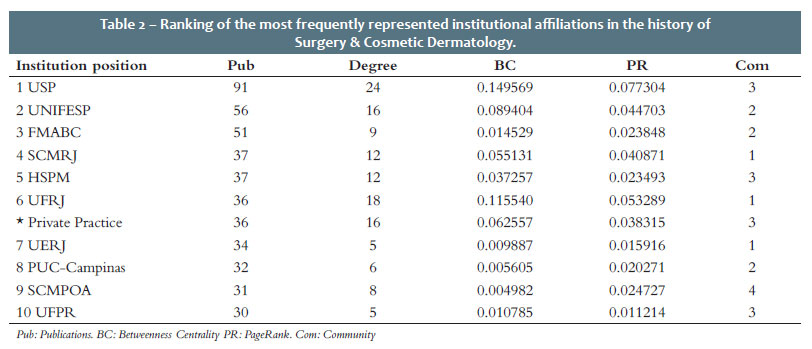
Regarding institutional affiliations, Table 2 presents the ten most frequently declared institutions, considering all authors of all articles, where the state of São Paulo stands out. Universidade de São Paulo (USP, Position 1) is the most frequently mentioned institution, appearing as the affiliation of one or more authors in 91 articles. It is followed by UNIFESP (Position 2), with 56 publications, and FMABC (Position 3), with 51. USP and UNIFESP show consistent performance, ranking among the top three in all metrics.
Universidade Federal do Rio de Janeiro (UFRJ, Position 6) also stands out, despite its lower absolute number of publications, due to its strong performance in the other metrics of betweenness centrality and influence in the co-authorship network. Rounding out the ranking are the SCM of Rio de Janeiro (Position 4), HSPM (Position 5), UERJ (Position 7), PUC-Campinas (Position 8), the SCM of Porto Alegre (Position 9), and UFPR (Position 10). It is important to note that the generic grouping under the label “Private Practice” was not included in this analysis, as it encompasses multiple unique institutions, which prevents individual identification.
The analysis of the four metrics allows for a comprehensive assessment of the network of institutions that have contributed to SCD. Publication count is a direct indicator of academic productivity. Degree quantifies the number of direct collaborations established with other institutions. Betweenness centrality, in turn, reveals the strategic role of certain institutions as links between different subgroups, facilitating the flow of knowledge and the integration of scientific communities. Finally, PageRank measures the structural influence of institutions based on the quality of their collaborations. Taken together, these metrics allow us to distinguish institutions with high productivity from those that play a central role in collaborative dynamics, contributing to the consolidation and dissemination of knowledge in surgical dermatology and cosmetic dermatology.
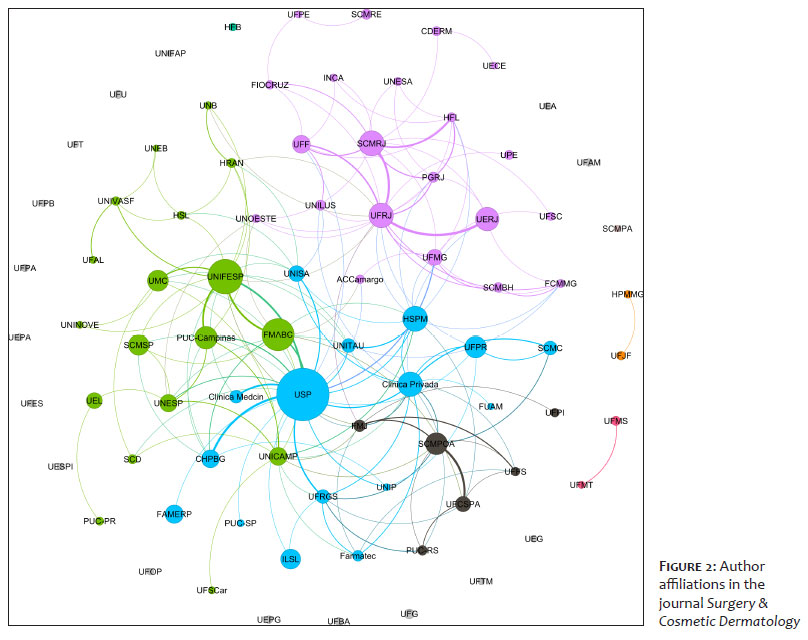
Figure 2 shows the network of scientific collaboration among institutions that contributed to SCD. The network structure shows the formation of four distinct interinstitutional communities, identified through modularity detection. Community 1, highlighted in magenta, is led by UFRJ and consists predominantly of institutions based in the state of Rio de Janeiro, as well as organizations from other states, such as Minas Gerais and several states in the Northeast, forming a network with relatively broad geographic coverage. Community 2, shown in green and led by UNIFESP and FMABC, concentrates institutions primarily located in the state of São Paulo, in addition to institutions from the Federal District and, to a lesser extent, Bahia, Alagoas, and Paraná. Community 3, in blue, has USP as its main node and brings together a dense network of institutions from São Paulo, also including several private practices, with limited connections to other regions, such as Paraná and Rio Grande do Sul. Community 4, in dark gray, is centered on SCMPOA and consists mainly of institutions from Rio Grande do Sul. There is also a subset of isolated or peripherally connected institutions that do not show clear co-authorship ties with other organizations, suggesting limited integration into institutional collaborative networks, which may negatively affect the circulation of knowledge and scientific visibility. The segmentation observed reflects both geographic and institutional ties as well as consolidated patterns of regional collaboration and thematic affinities within the field of surgical dermatology and cosmetology.
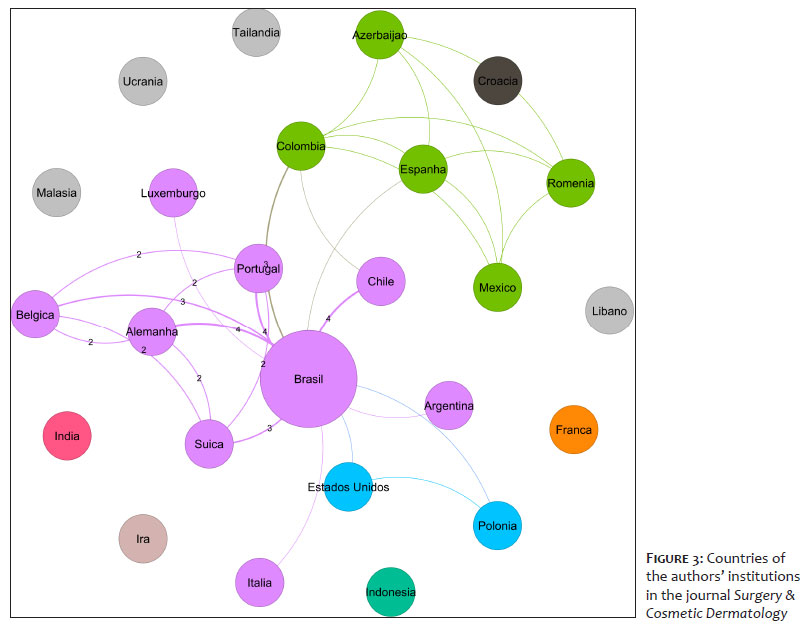
From the perspective of internationalization, Figure 3 shows the authors’ countries of affiliation and the extent of international collaborations. There is a strong national concentration, with Brazil overwhelmingly predominant, appearing in roughly 99% of all publications. This figure is expected, given the journal’s editorial scope, primary language, and historical connection with the Brazilian dermatological community. Authors from 22 foreign countries are also represented, although in significantly smaller proportions. Among the most frequent are Indonesia (n = 13), Portugal (n = 9), the United States (n = 8), and Chile (n = 7), followed by Colombia, Italy, Germany, and Iran, each with four or more contributions. This international participation, though modest, points to the gradual insertion of SCD into a broader scientific context and highlights its potential for internationalization. Some countries with strong traditions in dermatology, such as France and Spain, appear with a low number of publications, possibly reflecting the absence of specific indexations or a low degree of scientific exchange between these centers and SCD. The isolated presence of authors from countries such as Azerbaijan, Croatia, Lebanon, Malaysia, Romania, Thailand, and Ukraine, each with a single publication, suggests sporadic collaborations or isolated submissions rather than systematic integration with the scientific community surrounding the journal.
This uneven distribution indicates that there is strategic room for SCD to widen its international impact and visibility. Adopting editorial policies aimed at attracting manuscripts from foreign authors, inclusion in international databases, and promotion at global scientific events may extend the journal’s geographic reach and foster more robust interinstitutional collaborations. Thus, the distribution by country reaffirms SCD’s importance as a national scientific vehicle of excellence while also pointing to pathways for its expansion in the global landscape of surgical and cosmetic dermatology.
This study mapped the principal authors, institutions, and countries involved in SCD since its inception. A concentrated core of productive and influential researchers was identified within the network structure, along with strong institutional collaborations at the national level and limited international participation. Bibliometric and network metrics, such as publication count, degree of connectivity, betweenness centrality, and PageRank, provided complementary perspectives on productivity, collaborative articulation, and scientific influence. These results offer a comprehensive view of the journal’s editorial trajectory and reinforce its relevance as a vehicle for disseminating knowledge. Despite the predominance of contributions from Brazil, the findings indicate opportunities to broaden its international presence and refine editorial strategies.
Helena Cargnelutti Grimaldi
ORCID: 0009-0002-2762-4094
Author’s contribution: Approval of the final version of the manuscript, Effective participation in the conduct of the study, Critical review of the literature.
Sandro da Silva Camargo
ORCID: 0000-0001-8871-3950
Author’s contribution: Approval of the final version of the manuscript, Conception and design of the study, Preparation and writing of the
manuscript, Acquisition, analysis and interpretation of data.
1. Kadunc B. Surgical & Cosmetic Dermatology and Scientific Communication. Surg Cosmet Dermatol. 2018;10(3):187.
2. Kanmounye US, Sebopelo LA, Keke C, Zolo Y, Senyuy WP, Endalle G, et al. Mapping global neurosurgery research collaboratives: a social network analysis of the 50 most cited global neurosurgery articles. Neurosurg Open. 2021;2(2):okab006.
3. Furukawa HS, Cruz ACL, Brandão GSNB, Bagatin E. Cienciometria: uma ferramenta para inserção da Dermatologia brasileira na produção científica mundial. Surg Cosmet Dermatol. 2022;14:e20220148.
4. Musbahi A, Rao CB, Immanuel A. World J Surg. 2022;46(6):1314-24.
5. Song M, Liu Q, Guo H, Wang Z, Zhang H. Global trends and hotspots in robotic surgery over the past decade: a bibliometric and visualized analysis. J Robot Surg. 2024;19(1):33.
6. Cheng WM, Lee CH. International collaboration in Taiwan Emergency Department Publications: a social network analysis. J Acute Med. 2024;14(3):108-15.
7. Grimaldi HC, Camargo SS. Anais Brasileiros de Dermatologia: who wrote this century-old history? An Bras Dermatol. 2025;100(3):527-38.
8. DeVito NJ, Richards GC, Inglesby P. How we learnt to stop worrying and love web scraping. Nature. 2020;585(7826):621–2.
9. Hauge TC, Katz GE, Davis GP, Jaquess KJ, Reinhard MJ, Costanzo ME, et al. A novel application of Levenshtein distance for assessment of high-level motor planning underlying performance during learning of complex motor sequences. J Mot Learn Dev. 2020;8(1):67–86.
10. Logan R, Wehe AW, Woods DC, Tilly J, Khrapko K. Interpreting Sequence-Levenshtein distance for determining error type and frequency between two embedded sequences of equal length. ArXiv [Preprint]. 2023.
11. Lee YT, Chen SJ. Graph theory applications in congenital heart disease. Sci Rep. 2023;13:11135.
12. Hu X, Sun L, Zheng R, Xia X, Liu M, Chen W, Zhang X, Wang C, Liu T, Wang N. Application of graph theory in liver research: a review. Portal Hypertens Cirrhosis. 2024;3(4):234–48.
13. Cappelletti L, Rekerle L, Fontana T, Hansen P, Casiraghi E, Ravanmehr V, et al. Node-degree aware edge sampling mitigates inflated classification performance in biomedical random walk-based graph representation learning. Bioinform Adv. 2024;4(1):vbae036.
14. Xiang N, Wang Q, You M. Estimation and update of betweenness centrality with progressive algorithm and shortest paths approximation. Sci Rep. 2023;13:17110.
15. Evran T, Özçınar H, Çopur İ, Bilgili B. Bibliometric analysis of research trends and global collaborations in anesthesia on neuromuscular blockers and antagonists (2000-2024). Healthcare (Basel). 2025;13(10):1146.
16. Yao B, Zhu J, Ma P, Gao K, Ren X. A constrained louvain algorithm with a novel modularity. Appl Sci. 2023;13(6):4045.
 All content the journal, except where identified, under the Creative Commons Attribution 4.0 International licence - ISSN-e 1984-8773



 Read in Portuguese
 Portuguese PDF
 Print
Print
 Send this article by email
 How to cite this article
 Submit a comment
 Mendeley
 Pocket
 Share on Facebook
 Share on Twitter