


João Paulo Turri Brufatto; Marina Gagheggi Maciel; Adriana Salath Schikiera Martinelli; Giovanna Silva Barbosa; Thiago Jesse Kucarz; Luiz Roberto Dal Bem Pires Júnior; Renata Ferreira Magalhães; Thais Helena Buffo; Andréa Fernandes Eloy da Costa França; Elisa Nunes Secamilli
Funding: None
Conflict of interest: None
Submitted on: 05/28/2025
Final decision: 09/11/2025
How to cite this article: Brufatto JPT, Maciel MG, Martinelli ASS, Barbosa GS, Kucarz TJ, Pires Júnior LRDB, Magalhães RF, França AFEC, Buffo TH, Secamilli EN. Theoretical description of a local anesthesia protocol with non-pharmacological strategies for dermatological procedures in children. Surg Cosmet Dermatol. 2025; 17:e20250478.
Pain and anxiety management during pediatric dermatological procedures is a crucial aspect of medical care. Skin biopsies can cause stress and discomfort in children, negatively impacting the relationship between health care providers, patients, and caregivers. This study describes a local anesthesia protocol based on non-pharmacological techniques, consisting of prior explanation, parental support, visual distraction, and the use of cold or vibration before pharmacological anesthesia. Implementing this protocol may reduce pain and anxiety perception while offering a low-cost, low-tech, and safe care option.
Keywords: Dermatology; Pediatric Anesthesia; Biopsy; Pain
Pain and anxiety are fundamental aspects of the medical experience in the pediatric population, directly impacting treatment adherence, longitudinality of care, and the quality of care provided.1 Attention to these factors is critical to ensure a safer and more humanized environment,1 especially in invasive procedures such as skin biopsies.2
Pain is defined as an unpleasant sensory and emotional experience associated with actual or potential physical harm.3 This perception of pain may be intensified by psychosocial factors such as anxiety, fear of the unknown, and a sense of vulnerability.4 Dermatological procedures, such as skin biopsies, often trigger an uncontrolled anxiety response, making it essential to adopt effective strategies to reduce suffering for both children and their caregivers during medical procedures.5,6
Child mental health is a relevant factor to be considered, as it may compromise how the procedure is experienced and negatively influence longitudinality of care within the health system.7,8 Children who undergo painful procedures without adequate emotional support may develop fears and trauma related to medical visits, impairing adherence to necessary treatments.7,8 In addition, poorly managed pain may result in neurophysiological changes over time, increasing sensitivity to pain in future events and affecting the child’s perception of health care.7,8 Therefore, strategies that aim at minimizing pain and anxiety are critical to promoting more humanized care and improving the child’s experience of caring for their own health.9
A multidisciplinary approach to pediatric pain management is a frequent subject in the literature, combining play-based interventions and nonpharmacological techniques.5,6,9 However, the development of structured protocols remains uncommon in the scientific literature. The development of guidelines for pediatric dermatological procedures may represent an important contribution to improved clinical and emotional outcomes in children undergoing invasive procedures such as skin biopsies, and may also foster further research in this field.
Several studies indicate that the combination of local anesthesia with nonpharmacological methods, together with distraction techniques and emotional support, can significantly reduce pain and discomfort in children undergoing invasive procedures. The present study aimed to describe a local anesthesia protocol based on nonpharmacological therapies, using sensory distraction strategies and emotional support for skin biopsy procedures in children. The goal is to reduce pain perception, minimize anxiety, and improve cooperation among pediatric patients, thereby providing a more humanized experience.
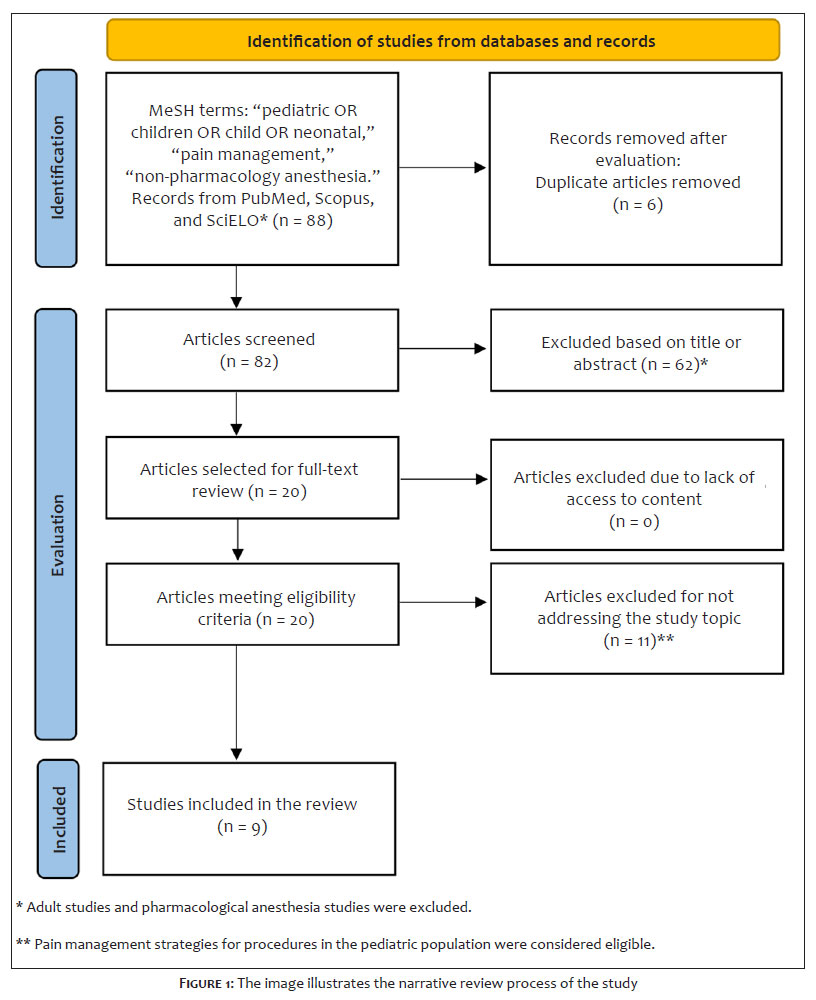
A narrative literature review was conducted using the PubMed, Scopus, and SciELO databases. Articles published within the last 5 years were selected using the following English descriptors (MeSH terms): “pediatric OR children OR child OR neonatal,” “pain management,” and “non-pharmacology anesthesia.” Inclusion criteria comprised clinical studies, systematic reviews, and meta-analyses addressing strategies for the management of pain and anxiety in children undergoing surgical procedures. Studies involving exclusively adult samples or addressing only pharmacological anesthesia without integration of non-pharmacological strategies were excluded. Figure 1 summarizes the results of the literature search.
Based on the data collected, a structured protocol for local anesthesia in children undergoing skin biopsies was developed, incorporating psychological and sensory approaches.
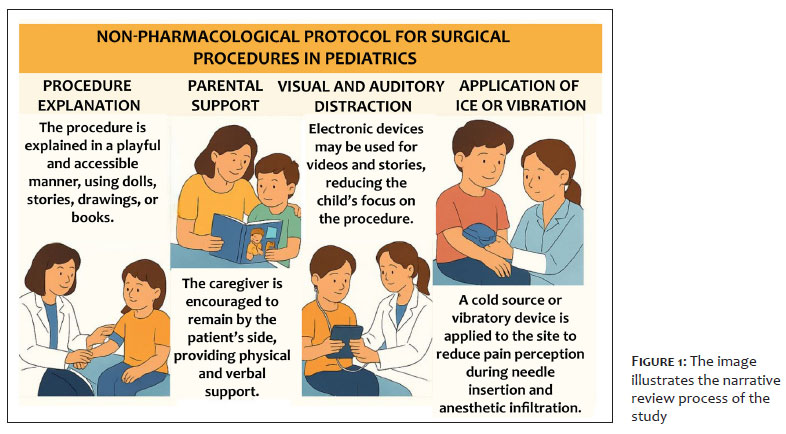
The protocol comprises four stages. The first stage consists of providing clear, age-appropriate explanations about the procedure, addressing both the child and their caregivers.9,10,11 The guidance should be presented in a playful and accessible manner, using resources such as stories, dolls, drawings, or illustrated books, with the aim of demystifying the experience and reducing procedure-related anxiety. 9,10,11 The second stage involves encouraging parental support, allowing the caregiver to remain by the child’s side during the procedure and promoting physical and verbal contact as a strategy to enhance the sense of emotional security.12,13 The third stage involves the use of visual and auditory distraction strategies, such as electronic devices to watch videos or listen to stories, helping to shift their focus away from the procedure and consequently reduce stress.9,14,15 Finally, the fourth stage refers to the application of sensory modulation measures, including prior use of ice or vibratory devices at the biopsy site, with the goal of minimizing the perception of pain associated with infiltration of the local anesthetic.16,17
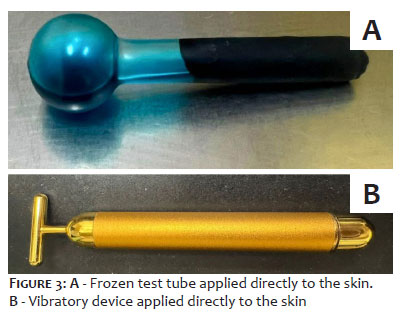
The protocol is summarized in Figure 2. Figure 3 illustrates the tools used in our hospital for the application of ice in (A) and vibration in (B).
The implementation of play-based strategies has been widely studied and recommended for pediatric patients in intensive care and oncology settings as effective methods to alleviate childhood anxiety and improve treatment adherence.18,19,20 The use of these strategies allows children greater control over their experience, promotes an understanding of pain beyond its exclusively physical dimension, reduces fear, and provides a more welcoming environment.19
Emotional support, including verbal encouragement and physical contact from parents, is essential for helping children feel safe.21 Studies show that parental presence and physical contact can lower cortisol levels, thereby decreasing the physiological stress response.21 In addition, prior preparation and clear, age-appropriate explanations of the procedure to both parents and patients can help reduce uncertainty about procedures, promoting a calmer experience for children.22,13
Many health care centers worldwide face challenges in performing procedures under general anesthesia in children due to the lack of anesthetic infrastructure, intravenous sedatives, or trained specialists.23 This limitation can represent a major obstacle to the investigation of serious dermatological conditions, such as genodermatoses or autoimmune diseases, which require histopathological examination for accurate diagnosis.24,25 The protocol described in this study offers a simple, accessible, and low-cost solution to facilitate dermatological diagnoses, enabling centers without high-complexity hospital infrastructure to advance the evaluation of complex cases.
In addition, the approach proposed in this study may contribute to improved family adherence to treatment, as a properly conducted procedure can strengthen the bond with the health care team and lower the resistance from both the child and their caregivers to medical care.13,25 This has a direct impact on the longitudinality of care, promoting more comprehensive clinical follow-up and potentially reducing the need for unnecessary interventions in the future.1,9
The combination of non-pharmacological techniques in pediatric pain management may also help build a more positive relationship between children and health care professionals.20 Children who experience a careful and humanized approach tend to develop greater trust in the medical team, which facilitates long-term care and promotes a more holistic approach to the health of patients and their caregivers across primary, secondary, and tertiary health care settings.27,28,29,30
The combination of local ice or vibration with distraction strategies and emotional support is an effective alternative for minimizing pain and anxiety in children undergoing skin biopsies. The protocol proposed in this study can be implemented in general dermatology services, offering an evidence-based approach to pediatric pain management. Future studies are needed to evaluate its effectiveness using objective measures of pediatric pain and comfort, as well as parameters such as duration and body surface area of ice application, thereby contributing to advances in pediatric dermatological care.
João Paulo Turri Brufatto
ORCID: 0000-0001-9752-377X
Statistical analysis, Approval of the final version of the manuscript, Conception and design of the study, Preparation and writing of the manuscript, Acquisition, analysis and interpretation of data, Effective participation in the conduct of the study, Intellectual participation in the propaedeutic and/or therapeutic approach to the cases studied, Critical review of the literature, Critical revision of the manuscript.
Marina Gagheggi Maciel
ORCID: 0000-0001-6077-4209
Approval of the final version of the manuscript, Conception and design of the study, Preparation and writing of the manuscript, Effective participation in the conduct of the study.
Adriana Salath Schikiera Martinelli
ORCID: 0000-0001-6723-9188
Approval of the final version of the manuscript, Conception and design of the study, Critical revision of the manuscript.
Giovanna Silva Barbosa
ORCID: 0000-0001-7217-2862
Critical review of the literature, Critical revision of the manuscript.
Thiago Jesse Kucarz
ORCID: 0009-0000-7339-3026
Critical review of the literature.
Luiz Roberto Dal Bem Pires Júnior
ORCID: 0009-0001-6728-420X
Preparation and writing of the manuscript, Intellectual participation in the propaedeutic and/or therapeutic approach to the cases studied.
Renata Ferreira Magalhães
ORCID: 0000-0001-9170-932X
Approval of the final version of the manuscript, Conception and design of the study.
Andréa Fernandes Eloy da Costa França
ORCID: 0000-0003-1657-4570
Approval of the final version of the manuscript, Conception and design of the study.
Thais Helena Buffo
ORCID: 0000-0002-6833-7596
Statistical analysis, Approval of the final version of the manuscript, Conception and design of the study.
Elisa Nunes Secamilli
ORCID: 0000-0001-9036-4200
Statistical analysis, Approval of the final version of the manuscript, Conception and design of the study, Preparation and writing of the manuscript, Acquisition, analysis and interpretation of data, Effective participation in the conduct of the study, Intellectual participation in the propaedeutic and/or therapeutic approach to the cases studied, Critical review of the literature, Critical revision of the manuscript.
1. Brito TRPD, Resck ZMR, Moreira DDS, Marques SM. As práticas lúdicas no cotidiano do cuidar em enfermagem pediátrica. Esc Anna Nery. 2009;13(4):802–8.
2. Arantes MGDA, Siqueira ALF, Pizzol AF, Sanna IP. Tratamento cirúrgico da síndrome de Klippel-Trenaunay em crianças: abordagens dermatológicas e cirurgia vascular. Rev Ibero-Am Humanid Ciênc Educ. 2024;10(10):633–44.
3. Forget P, Kahtan H, Jordan A. Personalized pain assessment: What does ‘acceptable pain’ mean to you? Eur J Pain. 2023;27(9):1139-43.
4. Fein JA, Zempsky WT, Cravero JP. Committee on Pediatric Emergency Medicine and Section on Anesthesiology and Pain Medicine. Relief of pain and anxiety in pediatric patients in emergency medical systems. Pediatrics. 2012;130:e1391.
5. Committee on Fetus and Newborn and Section on Anesthesiology and Pain Medicine. Prevention and management of procedural pain in the neonate: an update. Pediatrics. 2016;137(2):e20154271.
6. Witti N, Coynor S, Edwards C, Bradshaw H. A guide to pain assessment and management in the neonate. Curr Emerg Hosp Med Rep. 2016;4:1–10.
7. Valeri BO, Holsti L, Linhares MB. Neonatal pain and developmental outcomes in children born preterm: a systematic review. Clin J Pain. 2015;31(4):355–62.
8. Mathias EG, Pai MS, Kumar V, Narayanakurup D, Kulkarni M, Guddattu V. Nonpharmacological interventions for managing postoperative pain and anxiety in children: a randomized controlled trial. Clin Exp Pediatr. 2024.
9. Reducing Children's Preoperative Fear with an Educational Pop-up Book: A Randomized Controlled Trial Holly Cordray. Otolaryngol Head Neck Surg. 2022;167(2):366-74.
10. Berman L, Lingras K, Lin J, Berger JN, Hofflander M, Anderson L. Clinician perception of care at the end of life in a quaternary neonatal intensive care unit. Front Pediatr. 2023;11:1197360.
11. Freire RJB, Poeta L, Lôbo TERSB, Lôbo FB, Galvão MFG, Silva LDA. Estratégias para reduzir a ansiedade pré-operatória em pacientes pediátricos. Rev Contemp. 2024;4(3):e3425.
12. Scott MG, Smiley PA, Ahn A, Lazarus MF, Borelli JL, Doan SN. A mother's touch: preschool-aged children are regulated by positive maternal touch. Dev Psychobiol. 2022;64(1):e22272.
13. Peres T, Oliveira R, Publitz MR, Alves SC, Garcia MC, Soares LR. Estratégias de intervenção e tratamento para crianças e adolescentes com transtorno opositor-desafiador: uma revisão bibliográfica. RECIMA21. 2024;5(7):e575408.
14. Oliveira ER, Campos RO. Benefícios dos recursos lúdicos aplicados na psicologia hospitalar: revisão de literatura [Internet]. 2022 [citado 2024 dez 15]. Disponível em: https://zenodo.org/record/7347426
15. Tonetto LM, da Rosa VM, Brust-Renck P, Denham M, da Rosa PM, Zimring C. Playful strategies to foster the well-being of pediatric cancer patients in the Brazilian Unified Health System: a design thinking approach. BMC Health Serv Res. 2021;21:1-10.
16. Santos LGB. O uso da vibração associada à baixa temperatura no gerenciamento da dor durante punção venosa em crianças com cardiopatia congênita hospitalizadas [dissertação]. UERJ; 2024 [citado 2024 nov 2]. Disponível em: https://uerj.br.
17. Varshini I, Vinay C, Uloopi KS, RojaRamya KS, Chandrasekhar R, Penmatsa C. Effectiveness of pre cooling the injection site, laser biostimulation, and topical local anesthetic gel in reduction of local anesthesia injection pain in children. Int J Clin Pediatr Dent. 2021;14(1):81 3.
18. Demir Imamoglu Z, Aytekin Ozdemir A. The effect of a cognitive behavioural intervention package on peripheral venous cannulation pain, fear and anxiety in paediatric patients: randomised controlled trial. J Pediatr Nurs. 2024;72:e126–33.
19. Desalu I, Sarpong P, Osazuwa MO, Ndikontar Kwinji R, Faponle AF, Suleiman MK. Global pediatric anesthesia – Anglophone West Africa perspective. Paediatr Anaesth. 2024;34(1):74–84.
20. Aşkın Ö, Engin B, Gencebay G, Tüzün Y. A multistep approach to the diagnosis of rare genodermatoses. Clin Dermatol. 2020;38(6):722–8.
21. Peła Z, Gałecka M, Murgrabia A, Kondratowicz A, Gałecki P. Depressive disorder and dermatological autoimmune diseases. J Clin Med. 2024;13(1):123.
22. The cortisol response in parents staying with a sick child at hospital. Nurs Open. 2020;7(3):1012–8.
23. Chen J, Deng K, Yu D, Fan C, Liu L, Gu H. Recent developments in the non- pharmacological management of children's behavior based on distraction techniques: A concise review. Healthcare (Basel). 2024;12(2):156.
24. Espinosa Fernández MG, González-Pacheco N, Sánchez-Redondo MD, Cernada M, Martín A, Pérez-Muñuzuri A, et al. Sedoanalgesia in neonatal units. An Pediatr (Engl Ed). 2021;94(1):e1–8.
25. McNair M, Campbell-Yeo C, Johnston C, Taddio A. Non-pharmacologic management of pain during needle puncture procedures in infants: current research evidence and practical considerations: an update. Clin Perinatol. 2019;46(4):709–73.
26. Sabeti F, Mohammadpour M, Pouraboli B, Tahmasebi M, Hasanpour M. Health care providers' experiences of the non-pharmacological pain and anxiety management and its barriers in the pediatric intensive care units. J Pediatr Nurs. 2021;61:e52–8.
27. DeCosta P, Skinner TC, Grabowski D. The role of trust in the care of young children with type 1 diabetes. Children (Basel). 2021;8(5):351.
28. Waite-Jones JM, Swallow V, Madill A. From 'neurotic' to 'managing' mother: the 'medical career' experienced by mothers of a child diagnosed with juvenile idiopathic arthritis. Br J Health Psychol. 2020;25(1):170–88.
29. Cordray H, Patel C, Prickett KK. Reducing Children's Preoperative Fear with an Educational Pop-up Book: a Randomized Controlled Trial Holly Cordray. Otolaryngol Head Neck Surg. 2022;167(2):366-74.
30. Javed H, Oyibo SO, Alfuraih AM. Variability, validity and operator reliability of three ultrasound systems for measuring tissue stiffness: a phantom study. Cureus. 2022;14(11):e31731.
 All content the journal, except where identified, under the Creative Commons Attribution 4.0 International licence - ISSN-e 1984-8773




 Read in Portuguese
 Portuguese PDF
 Print
Print
 Send this article by email
 How to cite this article
 Submit a comment
 Mendeley
 Pocket
 Share on Facebook
 Share on Twitter