


Vitor Costa Fabris1,2; Inae Paula Battisti1; Maria Luísa Rocha Dadalt1
Funding: None
Conflict of interest: None
Submitted on: 1/8/2026
Final decision: 3/19/2026
How to cite this article: Fabris VC, Battisti IP, Dadalt MLR. Assessing acne treatment information on TikTok: A cross-sectional pilot study of Brazilian Portuguese content. Surg Cosmetc Dermatol. 2026;18(2):e20260544.
BACKGROUND: TikTok is a short-video platform popular among the young, the age group most affected by acne. Health-related content is often produced by creators without academic backgrounds in health care, raising concerns about information quality and reliability.
OBJECTIVE: To evaluate the educational quality, reliability, and evidence-based accuracy of TikTok videos on acne treatment in Brazilian Portuguese.
METHODS: The top 30 videos for “tratamento da acne” (acne treatment) were selected using a new TikTok account. Educational quality was assessed using the Patient Education Materials Assessment Tool for Audiovisual Materials (PEMAT-A/V), accuracy using the 2024 American Academy of Dermatology (AAD) Guidelines of Care for the Management of Acne Vulgaris, and reliability using the Journal of the American Medical Association (JAMA) Benchmark Criteria.
RESULTS: Only 10% of videos recommended treatments consistent with AAD guidelines. No non-medical creator provided correct recommendations, and only 33% of physician-created videos were correct. PEMAT-A/V scores were high, indicating well edited and understandable content, whereas JAMA scores were uniformly low, reflecting poor reliability..
CONCLUSIONS:Caution is warranted when using TikTok as a source of information on acne treatment in Brazilian Portuguese, as most videos analyzed were incorrect or imprecise.
Keywords: Acne Vulgaris; Cross-sectional studies; Social Media; Health Communication
TikTok is an online social network and short-video platform that has experienced rapid growth since its launch in 2017. It is characterized by short, engaging, user-generated videos and is particularly popular among individuals under 29 years of age, who account for approximately 60% of its audience.1 As the internet has become an important medium through which patients seek health information, there has been a notable increase in the creation of health-related videos on online social networks, including TikTok. Such content is produced not only by dermatologists, physicians, and health educators, but also by creators without formal academic training in health sciences, raising concerns about the quality and reliability of the information available on the platform.2
Most TikTok users fall within the age group most affected by acne.1,3 Due to their young age, insecurity about their looks, and high internet usage, this population is particularly vulnerable to online misinformation.4 Moreover, studies have shown that patients with acne actively seek therapeutic options online and may adopt treatments found on the internet without consulting a dermatologist or physician to determine whether the intervention is appropriate for their specific case.5
Considering that, if left untreated or if treatment is delayed, moderate and severe forms of acne can lead to scarring and long-term disfigurement,6 it is important to assess the quality of acne-related content to which patients are exposed on TikTok, as such content may negatively influence patient behavior. Studies have shown that videos about acne produced in English have low informational quality, even when created by health educators,7 but there is a lack of scientific literature addressing the Brazilian population. As internet usage trends vary across cultures,8 data from other populations may not accurately reflect the Brazilian context. Therefore, this study was designed to evaluate the educational quality, reliability, and evidence-based accuracy of TikTok videos on acne treatment in Brazilian Portuguese.
This was a cross-sectional study, with data collection conducted in March 2025 in the state of Santa Catarina, Brazil. A new user profile was created on TikTok to avoid algorithm training bias, and a search for “tratamento da acne” (Brazilian Portuguese term for “acne treatment”) was performed on the platform. The recommended Top Videos were screened individually, starting from the top, until 30 videos were identified that met the inclusion criteria: videos in Brazilian Portuguese recommending treatments for acne vulgaris. The videos were then saved for data extraction at a later date.
Two independent investigators extracted both quantitative (number of views, likes, shares, and video length) and qualitative (creator academic background and gender) data from the videos. The educational quality of the videos was assessed using the Patient Education Materials Assessment Tool for Audiovisual Materials (PEMAT-A/V),9 a validated instrument designed to measure how understandable and actionable health education materials are for patients. PEMAT-A/V scores range from 0% to 100%, with higher scores indicating better educational quality. Two investigators independently studied the PEMAT-A/V scale and underwent joint training to maximize consistency in their assessments. Given that the scale includes over 20 items, complete agreement was unlikely; therefore, the mean of their scores was used as the final value. For all other variables assessed in the study, a third researcher was consulted to resolve any disagreements.
It is important to note that the PEMAT-A/V does not evaluate the scientific accuracy of the content—a video may achieve a perfect score while presenting information that is not evidence-based. Taking this into account, and to allow for a more robust evaluation of evidence-based accuracy and reliability, the videos were also assessed using the Journal of the American Medical Association (JAMA) Benchmark Criteria10 and the 2024 Guidelines of Care for the Management of Acne Vulgaris of the American Academy of Dermatology11 (hereafter referred to as the 2024 AAD guidelines for the management of acne).
The JAMA Benchmark Criteria assess the quality and reliability of online health information across four domains: authorship, attribution, disclosure, and currency. Scores of 3 or 4 are generally considered indicative of high reliability, whereas scores of 2 or less suggest low reliability.
The 2024 AAD guidelines for the management of acne were used to assess whether treatment recommendations in the videos were correct, incomplete, or incorrect. Treatments for mild acne were considered correct if they included multimodal topical therapy comprising a retinoid (adapalene, tazarotene, tretinoin, or trifarotene), salicylic acid, or azelaic acid, combined with benzoyl peroxide (alone or with other topical antibiotics) and/or clascoterone. Treatments for moderate to severe acne were considered correct if they combined a systemic treatment with topical therapy or prescribed isotretinoin. Systemic treatments included systemic antibiotics (doxycycline, minocycline, or sarecycline), hormonal agents (combined oral contraceptives or spironolactone), and isotretinoin administered as a daily regimen rather than intermittently. Treatments were classified as incomplete if they recommended products included in the 2024 AAD guidelines for the management of acne but did not constitute a multimodal regimen for mild acne or failed to include systemic therapy for moderate-to-severe acne. The recommendation of any active ingredient not included in the guidelines was considered an incorrect treatment. All incorrect treatments were recorded and subsequently compiled for qualitative analysis. In addition, the investigators documented whether a video functioned as promotion for a single product, either through explicit company sponsorship or through self-reported financial benefit from product sales, and recorded the corresponding brand when applicable.
The initial study design did not include any statistical analysis, as it was not possible to anticipate whether the resulting videos would exhibit characteristics allowing for quantitative comparisons among pre-specified groups— for example, the study could have identified 30 videos created by the same category of creator, such as individuals without formal academic training in health sciences. For this reason, all statistical analyses were performed post hoc and should be regarded as exploratory, as no prior sample-size calculation was conducted.
For statistical analysis, the videos were divided into three groups: creators without a formal academic background in health care or aesthetics, creators with an academic background in health care or aesthetics, and medical doctors (including dermatologists).
Dermatologists were not classified separately from other medical doctors because the resulting number of videos per group would have been too low, reducing the sensitivity of the statistical power of the analysis. However, the quantitative and qualitative characteristics of videos produced by dermatologists were recorded in a subgroup and reported, even though they were not included in the formal statistical comparisons. Likes and shares of the videos were reported as percentages to serve as a measure of user engagement. While videos with more views tend to accumulate a higher absolute number of likes and shares, less popular videos may have a higher proportion of these interactions, indicating greater relative user engagement.
Normality was assessed using the Shapiro-Wilk test, with a p-value of 0.05 as the threshold for normality. Parametric data were reported as mean (standard deviation) and analyzed using one-way ANOVA, whereas non-parametric data were reported as median and interquartile range and analyzed using the Kruskal-Wallis test. Categorical variables were analyzed using the chi-square test. For all analyses, an alpha level of 0.05 was considered the threshold for statistical significance. Data analysis was performed using GNU PSPP software, version 2.0.0.
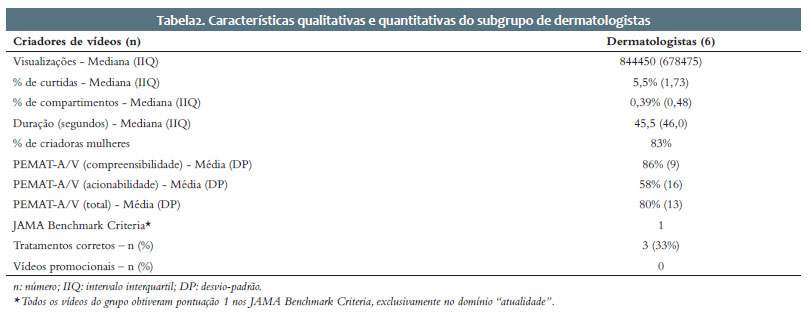
A total of 197 videos were screened, of which 30 met the study’s inclusion criteria. Videos were excluded if they were not in Brazilian Portuguese or did not address acne treatments (eg, those focusing on acne pathophysiology or personal patient experiences). Table 1 presents the data for each group, while Table 2 provides the results for the dermatologist subgroup. The group of video creators with an academic background in health care or aesthetics consisted of three pharmacists, three biomedical professionals, and one aesthetician.
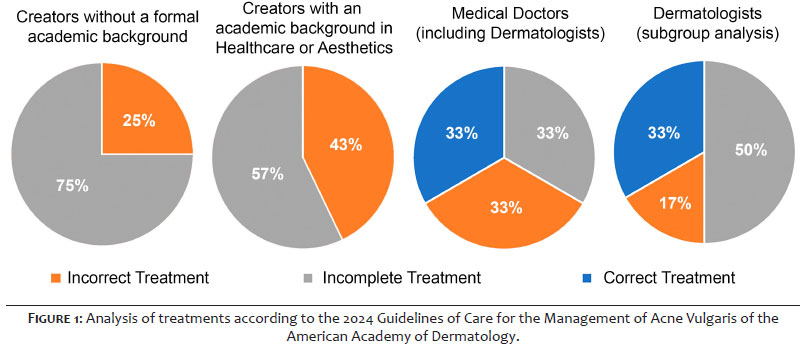
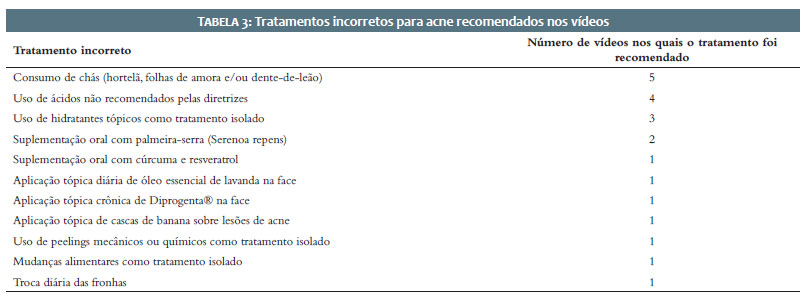
Figure 1 illustrates the rates of correct, incorrect, and incomplete treatment recommendations in each group, including the subgroup analysis of dermatologist-created videos. Table 3 summarizes all incorrect treatments recommended in the videos.
Seven of the 30 videos were promotional in nature, corresponding to 23% of the sample. Three were from Creamy, 2 from Visara, 1 from Beiersdorf, and 1 from TheraSkin
These results provide insights into the current landscape of TikTok videos on acne treatment. First, the quality of treatments recommended in the most-viewed videos is very low—only 10% of the videos recommended treatments in accordance with the 2024 AAD guidelines for the management of acne. Notably, none of the creators without a medical degree recommended correct acne treatments, and even among physicians, the rate of correct recommendations was low (33%). This finding is in line with studies assessing the quality of videos about acne in American English7 and is consistent with research in other areas of medicine, where TikTok videos have been shown to provide low-quality information on topics such as oncology,12-14 urology,15-17 and cardiology.18 It is likely that this trend of online misinformation on TikTok extends across all areas of medicine, and one potential explanation may be reflected in the PEMAT-A/V scores observed in the videos analyzed in this study.
PEMAT-A/V scores were high for all videos included in this study, regardless of creator background. This suggests that, on TikTok, video formatting may be more important than content for achieving high view counts and engagement. High PEMAT-A/V scores indicate that the videos were well edited and easily understandable to the audience, even when conveying health misinformation. Research in education has shown that student perceptions of lecture quality are often influenced more by lecturer charisma than by the content of the lecture itself.19 A similar phenomenon may occur with audiovisual content on TikTok: the manner in which the message is delivered may be more influential than the message itself in reaching wide audiences. This does not imply that evidence-based, high-quality videos on acne treatment do not exist on TikTok, but the results of this study suggest that such videos are not reaching broader audiences effectively.
One of the primary barriers to effective, evidence-based science communication on TikTok is its short-video format. Median video length in this study was approximately 1 minute, often too short to convey the complexity required for prescribing evidence-based acne treatments. This structural limitation likely contributes to the poor quality of medical content disseminated. Notably, none of the 30 videos assessed achieved a score higher than 1 on the JAMA Benchmark Criteria, with that single point awarded stemming from the platform’s automatic disclosure of the publication date rather than from any deliberate effort by content creators to ensure transparency or reliability. Most videos lasted less than 90 seconds, and creators carefully optimize the content presented within this brief time frame. Consequently, creators may omit information on potential conflicts of interest or the sources used to support their content, as such details are unlikely to interest the average viewer. The result is that the most-viewed videos on acne treatment frequently rely on a fallacy known as the argument from authority, or appeal to authority20—the perceived correctness of a treatment is judged based on the status of the person recommending it rather than on an evidence-based approach. Without disclosure of conflicts of interest or sources, viewers have no means of verifying the claims presented. This is particularly concerning given that only 33% of videos produced by dermatologists recommended correct acne treatments, as the audience is likely to perceive these creators as authoritative figures in acne management.
The skincare market is closely linked to acne treatment and is projected to generate revenues of US$198.35 billion worldwide in 2025.21 Our study suggests that this industry is successfully leveraging online social network marketing, as 7 of the 30 most-viewed videos on acne treatment were promotional in nature. This may further degrade the health care information consumed by TikTok users, as marketing on the platform is poorly regulated, raising concerns regarding transparency, disclosure, and potentially misleading content.22
Another notable finding of our study is that approximately half of the incorrect treatments recommended in the videos (Table 3) involved home-based remedies for acne, including teas, supplements, and lifestyle changes. This is consistent with studies showing that up to 80% of patients use non-pharmacological, home-based remedies for their illnesses.23,24 Specifically for acne, it has been estimated that up to 80% of female patients who follow acne advice online adopt either home-based remedies or dietary changes.25 This behavior is concerning, as acne is a potentially scarring disease, and delays in effective treatment may result in poorer cosmetic outcomes.6 The incorrect treatments portrayed in these videos are also consistent with key themes of acne misinformation identified in previous studies.4 They include the pursuit of natural remedies, the belief that dietary changes can cure the disease, and the search for “miracle cures”—the idea that a single treatment can resolve acne.4 The pursuit of a miracle cure may also explain why some patients cycle through different topical treatments, even for moderate to severe acne, before seeking specialized care, failing to recognize that the issue lies not with the products used but with the need for systemic treatment.
The present study has some limitations, however. The constant influx of new videos on TikTok, as well as the undisclosed variables the platform uses to recommend content,26 limits the replicability of our findings. Even though our sample of videos was relatively small, the small sample size was intentional, as the study focused exclusively on the best-performing videos on the platform.
These results provide insights into the current landscape of TikTok videos on acne treatment in Brazilian Portuguese. The quality of treatments recommended in the most-viewed videos was very low: only 10% provided treatment recommendations fully in line with the 2024 AAD guidelines for acne management. None of the creators without a medical degree recommended correct treatments, and even among physicians, the rate of correct recommendations was low (33%). On the other hand, the videos were generally well edited, engaging, and easy to understand, as reflected by their high PEMAT-A/V scores. Given these characteristics, coupled with low JAMA Benchmark Criteria scores—which indicate that viewers cannot reliably assess whether the proposed treatments are supported by legitimate sources—caution is warranted regarding the use of TikTok as a source of information on acne treatment. Most treatments recommended in the most-viewed videos in Brazilian Portuguese analyzed in this study were either incorrect or incomplete.
Our findings also highlight the importance of physician participation—particularly that of dermatologists—in the production of health education content about acne on social networks. In our dataset, none of the videos published by creators without a medical degree fully adhered to the treatment recommendations of the 2024 AAD guidelines for the management of acne, while the subgroup of videos created by dermatologists showed the highest level of adherence to evidence-based recommendations.
Vitor Costa Fabris
ORCID: 0000-0002-3540-2769
Statistical analysis, Approval of the final version of the manuscript, Conception and design of the study, Preparation and writing of the manuscript, Acquisition, analysis and interpretation of data, Effective participation in the conduct of the study, Critical review of the literature, Critical revision of the manuscript.
Inae Paula Battisti
ORCID:0009-0008-8182-5835
Conception and design of the study, Preparation and writing of the manuscript, Acquisition, analysis and interpretation of data, Critical review of the literature, Critical revision of the manuscript.
Maria Luísa Rocha Dadalt
ORCID: 0000-0001-8497-0546
Approval of the final version of the manuscript, Conception and design of the study, Preparation and writing of the manuscript, Effective participation in the conduct of the study, Critical review of the literature, Critical revision of the manuscript.
1. Jain L, Velez L, Karlapati S, Forand M, Kannali R, Yousaf RA, et al. Exploring Problematic TikTok Use and Mental Health Issues: A Systematic Review of Empirical Studies. J Prim Care Community Health. 2025;16:21501319251327303.
2. Campbell J, Williams K, Woolery-Lloyd H. DermTok: How TikTok Is Changing the Landscape of Dermatology Patient Education. J Drugs Dermatol. 2023;22(3):302-4.
3. Kutlu Ö, Karadağ AS, Wollina U. Adult acne versus adolescent acne: a narrative review with a focus on epidemiology to treatment. An Bras Dermatol. 2023;98(1):75-83.
4. O'Connor C, O'Grady C, Murphy M. Spotting fake news: a qualitative review of misinformation and conspiracy theories in acne vulgaris. Clin Exp Dermatol. 2022;47(9):1707-11.
5. Ertekin SS, Salici NS, Manav Bas V, Karali MG, Ergün EZ, Avcı EB, et al. Influence of Social Media and Internet on Treatment Decisions in Adult Female Acne Patients: A Cross-Sectional Survey Study. Dermatol Pract Concept. 2024;14(3):e2024156.
6. Rocha M, Barnes F, Calderón J, Fierro-Arias L, Gomez CEM, Munoz C, et al. Acne treatment challenges - Recommendations of Latin American expert consensus. An Bras Dermatol. 2024;99(3):414-24.
7. Irfan B, Yasin I, Yaqoob A. Navigating Digital Dermatology: An Analysis of Acne-Related Content on TikTok. Cureus. 2023;15(9):e45226.
8. Hermeking, Marc. Culture and Internet Consumption: Contributions from Cross-Cultural Marketing and Advertising Research. J. Computer-Mediated Communication. 2005;11:192-216.
9. Shoemaker SJ, Wolf MS, Brach C. Patient Education Materials Assessment Tool for Audiovisual Materials (PEMAT-A/V). Rockville, MD: Agency for Healthcare Research and Quality; 2013. Report No.: AHRQ Publication No. 14-0002-EF.
10. Silberg WM, Lundberg GD, Musacchio RA. Assessing, controlling, and assuring the quality of medical information on the Internet: Caveant lector et viewor—Let the reader and viewer beware. JAMA. 1997;277(15):1244–5.
11. Reynolds RV, Yeung H, Cheng CE, Cook-Bolden F, Desai SR, Druby KM, et al. Guidelines of care for the management of acne vulgaris. J Am Acad Dermatol. 2024;90(5):1006.e1–1006.e30.
12. Ayer D, Jain A, Singh M, Tawfik A, Tadros M. Understanding TikTok's Role in Young-Onset Colorectal Cancer Awareness and Education. J Cancer Educ. 2025.
13. Duggal S, Mahapatra S, Garrison K, Robles A. Assessing Gastrointestinal Awareness on TikTok: A Content Analysis of Colorectal Cancer, IBS, and IBD Narratives. Am J Gastroenterol. 2025;120(8):1870-3.
14. Zhu W, He B, Wang X, Du Y, Young K, Jiang S. Information quality of videos related to esophageal cancer on tiktok, kwai, and bilibili: a cross-sectional study. BMC Public Health. 2025;25(1):2245.
15. O'Sullivan NJ, Nason G, Manecksha RP, O'Kelly F. The unintentional spread of misinformation on 'TikTok'; A paediatric urological perspective. J Pediatr Urol. 2022;18(3):371-5.
16. Salka B, Aljamal M, Almsaddi F, Kaakarli H, Nesi L, Lim K. TikTok as an Educational Tool for Kidney Stone Prevention. Cureus. 2023;15(11):e48789.
17. Wong HPN, So WZ, Senthamil Selvan V, Lee JY, Ho CERH, Tiong HY. A cross-sectional quality assessment of TikTok content on benign prostatic hyperplasia. World J Urol. 2023;41(11):3051-7.
18. Gong X, Zhang Z, Dong B, Pan H. TikTok's cardiopulmonary exercise testing videos: A content analysis of quality and misinformation. Digit Health. 2025;11:20552076251341090.
19. Ware JE Jr, Williams RG. The Dr. Fox effect: a study of lecturer effectiveness and ratings of instruction. J Med Educ. 1975;50(2):149-56.
20. Logically Fallacious: The Ultimate Collection of Over 300 Logical Fallacies (Academic Edition). 1st ed. San Francisco, CA: Academic Edition; 2012.
21. Statista [Internet]. Skin Care – Worldwide. Statista. [Cited September 10, 2025]. Available from: https://www.statista.com/outlook/cmo/beauty-personal-care/skin-care/worldwide
22. Maharany, Sylvana. Consumer Protection in the Digital Economy Era: Tiktok Shop Case Study. JISIP (Jurnal Ilmu Sosial dan Pendidikan). 2024;8:1652.
23. Parisius LM, Stock-Schröer B, Berger S, Hermann K, Joos S. Use of home remedies: a cross-sectional survey of patients in Germany. BMC Fam Pract. 2014;15:116.
24. Winkler NE, Sebo P, Haller DM, Maisonneuve H. Primary care patients' perspectives on the use of non-pharmacological home remedies in Geneva: a cross-sectional study. BMC Complement Med Ther. 2022;22(1):126.
25. Ertekin SS, Salici NS, Manav Bas V, Karali MG, Ergün EZ, Avcı EB, et al. Influence of Social Media and Internet on Treatment Decisions in Adult Female Acne Patients: A Cross-Sectional Survey Study. Dermatol Pract Concept. 2024;14(3):e2024156.
26. Zhou, Ren. Understanding the Impact of TikTok's Recommendation Algorithm on User Engagement. International Journal of Computer Science and Information Technology. 2024;3:201-8.
 All content the journal, except where identified, under the Creative Commons Attribution 4.0 International licence - ISSN-e 1984-8773



 Read in Portuguese
 Portuguese PDF
 Print
Print
 Send this article by email
 How to cite this article
 Submit a comment
 Mendeley
 Pocket
 Share on Facebook
 Share on Twitter