


Alessandra Encarnação de Morais1; Lizandra Cunha De Carvalho1; Beatriz Cavalcante de Carvalho1; Bruno dos Santos Vásquez2; Luciana Mendes dos Santos1; Virgínia Vilasboas Figueiras1; Rima de Souza Raad1
Funding: None
Conflict of interest: None
Submitted on: 05/18/2025
Final decision: 08/28/2025
How to cite this article: Manzoni APD, Lorenzini FK, Gauer TB, Thomé BB, Bonamigo RR. Non-surgical management of ectropion using hyaluronic acid gel with cannula injection. Surg Cosmet Dermatol. 2025;17:e20250470.
Loxoscelism is caused by the bite of a spider of the genus Loxosceles and can result in severe skin lesions. This report describes a case of cutaneous loxoscelism in a young patient with type 1 diabetes mellitus who underwent surgical debridement and coverage with a polypropylene prosthesis using the Figueiredo technique after administration of antiloxoscelic serum and antibiotic therapy. This approach proved to be a low-cost and effective alternative, although it resulted in loss of mobility and local atrophy.
Keywords: Wounds and Injuries; Prostheses and Implants; Spider Bites
Loxoscelism is a clinical condition resulting from bites by spiders of the genus Loxosceles, characterized by necrotic skin lesions and, in more severe cases, systemic manifestations.1 Several therapeutic interventions have been proposed, including the use of anti-Loxosceles antivenom, dapsone, corticosteroids, and antibiotics.2 However, a definitive therapeutic approach has not yet been established, especially in cases involving the extremities, which require special attention given their anatomical complexity and functional importance.3 The Figueiredo technique, which uses polypropylene prostheses fashioned from saline bags, represents a low-cost alternative for coverage of lesions in extremities and may prevent amputations.4
This is the case report of an 18-year-old male patient with poorly controlled type 1 diabetes mellitus, who sought medical care 36 hours after a spider bite on the distal phalanx of the right second digit. Clinical, laboratory, and imaging examinations were performed, followed by clinical and surgical treatment as described below.
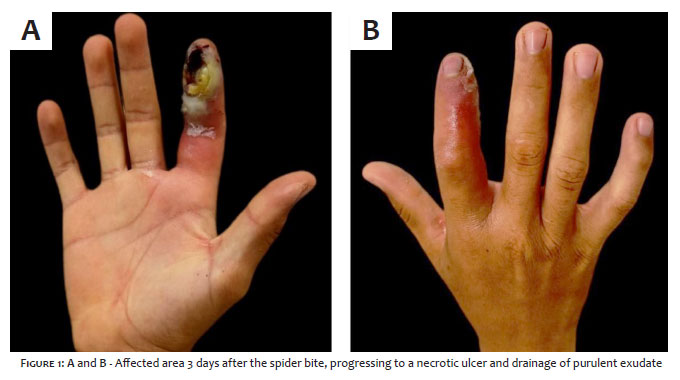
On physical examination, the patient presented with a necrotic ulcer with drainage of purulent exudate on the second digit of the right hand, measuring 3.1 cm at its greatest diameter, associated with blisters, edema, erythema, and warmth involving flexor zones 1 and 2, with dorsal extension (Figure 1).
Due to the clinical course and epidemiology, a diagnosis of cutaneous loxoscelism was considered, and anti-Loxosceles antivenom and antibiotic therapy were initiated. In complementary tests, the patient presented leukocytosis with neutrophilia, but no findings indicative of hemolysis. Creatine kinase was monitored at admission and again after 12 hours, remaining within reference values. Blood and urine cultures were negative. Soft-tissue ultrasonography and radiographs were requested to assess the extent of the condition and rule out differential diagnoses. The examinations revealed a cystic-thickened formation, increased skin thickness, and blurring of the adjacent adipose planes, compatible with an inflammatory/infectious process suggestive of abscess, with no signs of necrotizing fasciitis or osteomyelitis.
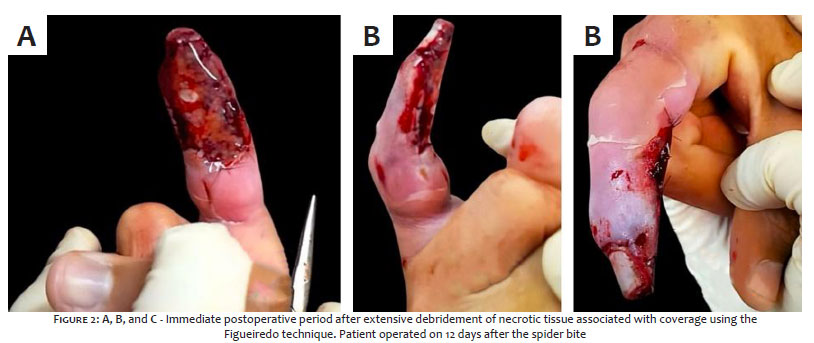
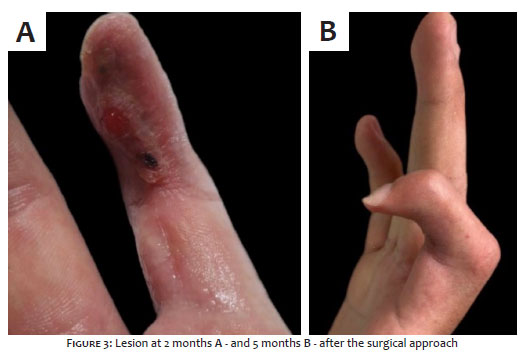
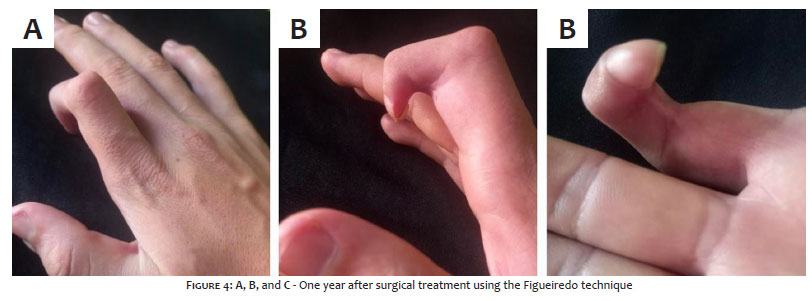
Surgical debridement was performed, exposing the deep flexor tendon of the second digit, followed by repeat debridement by the hand surgery service, with complete resection of necrotic tissue. This exposed vital structures, including the radial and ulnar digital nerves, the superficial and deep flexor tendons, and the digital arteries. The options for coverage of these vital structures were a microsurgical free flap, a pedicled flap, or the Figueiredo technique. Given the comorbidity of poorly controlled type 1 diabetes mellitus, coverage by the Figueiredo technique was chosen, using a polypropylene prosthesis fashioned from a saline bag and cut to match the dimensions of the lesion. Fixation was performed at the edges of intact skin with simple, closely spaced sutures, avoiding excessive tension. The prosthesis was positioned in direct contact with the wound and with the vital structures, without exerting pressure, in order to provide mechanical protection and a favorable environment for cellular regeneration (Figure 2). After suturing, a dry dressing with sterile gauze and micropore tape was applied, first changed after 7 days. Dressings were changed weekly until the prosthesis was removed at 60 days postoperatively. The patient remains under multidisciplinary outpatient follow-up, with good clinical progression, limb preserved, but with reduced range of motion (Figures 3 and 4).
Surgical management of loxoscelism with involvement of extremities represents a clinical challenge, particularly in patients with comorbidities such as type 1 diabetes mellitus, which impairs tissue healing. The decision to proceed with early surgical debridement was essential to contain the infection, allow adequate wound cleansing, and preserve the exposed vital structures.
The use of the Figueiredo technique, originally described for closure of traumatic fingertip injuries, has proven to be an effective, safe, and low-cost approach, especially in resource-limited settings and in patients at high risk of surgical complications.4 In recent case series, the technique has achieved good functional and cosmetic outcomes, in addition to enabling adequate coverage of tendons, nerves, and vessels in extremities without requiring microsurgical flaps.5
In this case report, application of the polypropylene prosthesis fashioned from a saline bag provided a moist, stable, and protected environment, promoting granulation and progressive epithelialization of the wound. The material proved compatible with the wound bed and was well tolerated, supporting previous reports regarding its biocompatibility and effectiveness.6
Despite the favorable outcome, partial loss of range of motion of the affected digit was observed at the end of the healing process. This functional limitation is consistent with studies highlighting the need for early rehabilitation and multidisciplinary follow-up after healing of deep injuries to the hands and fingers.7
This case report contributes to the literature by emphasizing the effectiveness of a low-cost and functional surgical approach, as well as underscoring the importance of careful assessment and a multidisciplinary approach in patients with complex lesions.
This case report demonstrates that the Figueiredo technique, using a polypropylene prosthesis, represents an effective, low-cost, and technically simple surgical alternative for the management of deep skin lesions of extremities affected by loxoscelism. Coverage of the critical structures with an inert and malleable material enabled limb preservation, even in a patient with risk factors for impaired wound healing.
Although the functional outcome was limited by atrophy and loss of mobility, the clinical outcome was satisfactory given the initial severity of the condition, avoiding amputation. The importance of early functional rehabilitation and multidisciplinary follow-up should be stressed. Thus, the Figueiredo technique should be considered a valid therapeutic option in similar scenarios, particularly in regions with restricted access to more complex resources.
Alessandra Encarnação de Morais
ORCID: 0000-0001-8991-9109
Conception and design of the study, Preparation and writing of the manuscript, Acquisition, analysis and interpretation of data, Intellectual participation in the propaedeutic and/or therapeutic approach to the cases studied.
Lizandra Cunha de Carvalho
ORCID: 0009-0007-4638-116X
Conception and design of the study, Preparation and writing of the manuscript, Acquisition, analysis and interpretation of data.
Beatriz Cavalcante de Carvalho
ORCID: 0009-0008-8775-7407
Preparation and writing of the manuscript, Intellectual participation in the propaedeutic and/or therapeutic approach to the cases studied, Critical review of the literature.
Bruno dos Santos Vásquez
ORCID: 0000-0002-6892-3659
Preparation and writing of the manuscript, Effective participation in the conduct of the study, Intellectual participation in the propaedeutic and/or therapeutic approach to the cases studied, Critical review of the literature.
Luciana Mendes dos Santos
ORCID: 0000-0002-3598-8237
Approval of the final version of the manuscript, Effective participation in the conduct of the study, Intellectual participation in the propaedeutic and/or therapeutic approach to the cases studied, Critical review of the literature, Critical revision of the manuscript.
Virgínia Vilasboas Figueiras
ORCID: 0000-0003-1960-5328
Intellectual participation in the propaedeutic and/or therapeutic approach to the cases studied, Critical revision of the manuscript.
Rima de Souza Raad
ORCID: 0009-0008-8059-1854
Effective participation in the conduct of the study, Intellectual participation in the propaedeutic and/or therapeutic approach to the cases studied, Critical review of the literature, Critical revision of the manuscript.
1. Isbister GK, Fan HW. Spider bite. Lancet. 2011;378(9808):2039–47.
2. Lopes PH, Squaiella-Baptistão CC, Marques MOT, Tambourgi DV. Clinical aspects, diagnosis and management of Loxosceles spider envenomation: literature and case review. Arch Toxicol. 2020;94(5):1461–77.
3. Olan-De Los Santos AI, Manzo-Castrejón HA, Corona-Díaz E, et al. Surgical versus medical management in cutaneous loxoscelism: systematic review and update. Cir Gen. 2023;45(3):160-74.
4. Figueiredo LA, Ribeiro RS, Melo ALB, Lima AL, Terra BB, Ventim FC. Uso da prótese de polipropileno para o tratamento das lesões em ponta de dedo. Descrição de técnica cirúrgica e resultados. Rev Bras Ortop. 2017;52(6):685–92.
5. Carrai LHM, Alves VCA, Leite WCM, Silveira NFG, Martins JAS. Fechamento cirúrgico tardio (segunda intenção) pela técnica de Figueiredo: série de casos. Surg Cosmet Dermatol. 2022;14:e20220103.
6. Gomes ACS, Barreto FP, Medeiros RMC, Ferreira DO, Chaves CC. Use of Figueiredo’s technique for treating extensive infected skin lesions – case report. J Foot Ankle. 2024;18(1):70–3.
7. Araújo JJ, Marques TFO, Sousa AL, Pacheco DM, Oliveira LRL. Uso da técnica de Figueiredo em lesões com exposição ósseo-tendínea: revisão de literatura. Cad Pesq. 2025;32(1):e14605.
 All content the journal, except where identified, under the Creative Commons Attribution 4.0 International licence - ISSN-e 1984-8773




 Read in Portuguese
 Portuguese PDF
 Print
Print
 Send this article by email
 How to cite this article
 Submit a comment
 Mendeley
 Pocket
 Share on Facebook
 Share on Twitter