


João Marcos Franco de Souza; Barbara Messias Pereira; Bianca Miyazawa; Carlos Borges Junior; Rogerio Nabor Kondo
Funding: None
Conflict of interest: None
Submitted on: 2/6/2026
Final decision: 4/9/2026
How to cite this article: Souza JMF, Pereira BM, Miyazawa B, Borges Junior C, Kondo RN. Pinwheel flap: a series of two cases. Surg Cosmet Dermatol. 2026;18(2):e20260556.
Scalp reconstructions can be challenging for dermatologic surgeons because the site has little elasticity and is located over a convex, rather than flat, area. The pinwheel flap is a type of rotational flap used for the vertex region of the scalp. We describe two cases, one male and one female, using the technique to reconstruct defects after skin cancer excisions in the vertex and the frontal region of the scalp.
Keywords: Scalp; Carcinoma, Basal Cell; Carcinoma, Squamous Cell; Surgical Flaps
Basal cell carcinoma (BCC) and squamous cell carcinoma (SCC) are the two most common types of skin cancer.1 When located on the scalp, surgical treatment can be challenging because the scalp is a convex, non-flat surface, and even relatively small defects may require flaps or grafts due to poor local tissue elasticity.2
The pinwheel flap was originally developed to correct circular defects on the scalp, specifically to overcome the limited mobility of the scalp skin, but it has also been used in other regions of the face. It consists of three or more flaps that, through rotational movement, allow local defect closure.3,4
We report two cases of patients with SCC and BCC of the scalp for whom the pinwheel flap was selected for reconstructive surgery, achieving satisfactory aesthetic outcomes.
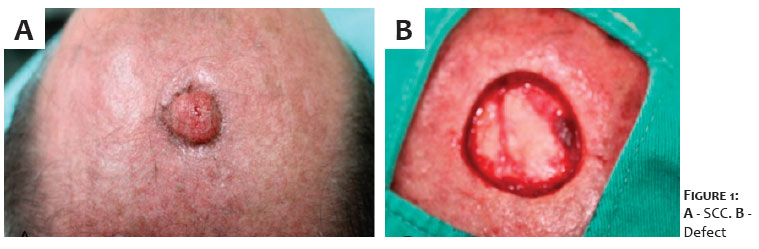
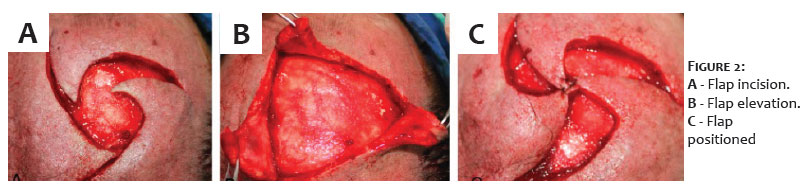
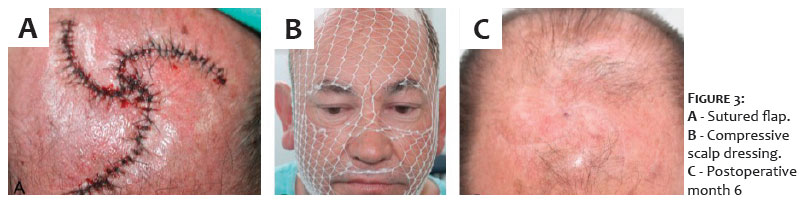
A 57-year-old male patient presented with a 19-mm plaque in the central region of the scalp. A previous incisional biopsy found SCC on histopathological examination. Excision with 5-mm margins was performed, resulting in a 29-mm defect, followed by reconstruction with a pinwheel flap (Figures 1, 2 and 3).
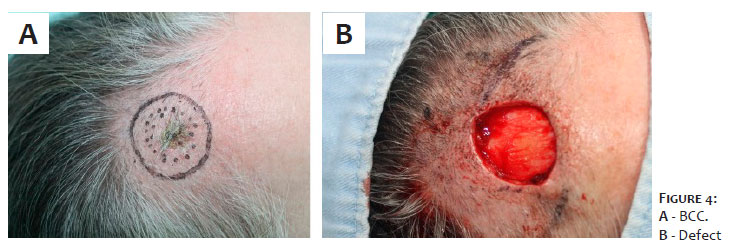
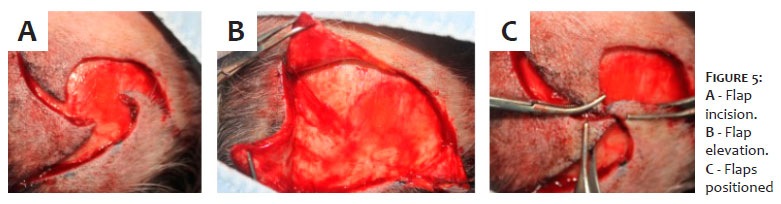
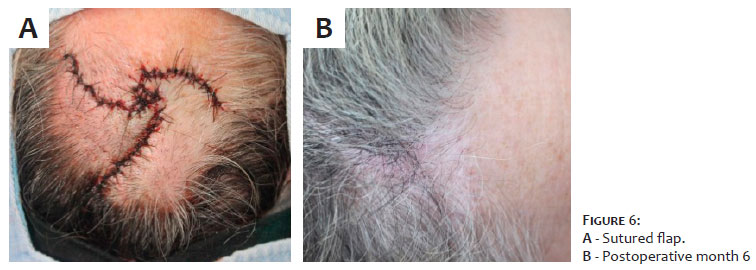
A 47-year-old female patient presented with a 16-mm plaque in the right frontal scalp region. A previous incisional biopsy found BCC on histopathological examination. Excision with 5-mm margins was performed, resulting in a 26-mm defect, followed by reconstruction with a pinwheel flap (Figures 4, 5 and 6).
a) Patient in horizontal supine position;
b) Antisepsis with topical 10% polyvinyl iodine;
c) Placement of surgical drapes;
d) Infiltrative anesthesia with 2% lidocaine with vasoconstrictor;
e) Incision with a 15-blade and en bloc circular excision of the lesion (Figures 1B and 4B);
f) Incisions and creation of rotational flaps (Figures 2A, 2B, 5A, and 5B);
g) Positioning of the rotational flaps (Figures 2C and 5C);
h) Simple suture with 4-0 monofilament nylon (Figures 3A and 6A);
i) Cleaning with saline;
j) Occlusive dressing with gauze and compressive scalp dressing (Figure 3B).
The patients were followed at 1, 3, 6, and 12 months. Histopathological examination found tumor-free margins for SCC and BCC, respectively. Both patients showed good wound healing, with no signs of recurrence and satisfactory aesthetic outcomes (Figures 3C and 6B)
Skin flaps or grafts may be necessary for closure following excision of scalp skin tumors.2 Because they preserve adjacent skin with similar characteristics,3 flaps are generally preferred over grafts, particularly to avoid alopecia in female patients, as in Case 2.2
In 1978, Vecchione and Griffith used three-part flaps rotated in the same direction to close a circular scalp defect, creating a pinwheel-like design (Figures 3A and 6A). It became a classic for use on the scalp vertex and was later extended to other scalp regions. Currently, the pinwheel flap is also used beyond the scalp, including non-hair-bearing nasal and temporal regions.3,4
One advantage of the pinwheel flap is that it can be performed in a single surgical time, unlike interpolation flaps. Because it does not require tie-over pressure dressing, as skin grafts do, it is also more comfortable for the patient.2
One option for maintaining compressive dressing for 24 hours, while preventing hemorrhage or hematoma without the need for technically demanding elastic bandages, is the Kondo compressive scalp dressing (Figure 3B).5
In Case 2, unlike Case 1, reconstruction was somewhat more challenging because the patient was female, had no androgenetic alopecia, and the lesion was located in the frontal scalp region. The flaps were designed to allow adequate rotation and defect closure while preventing the scars from extending beyond the hairline.
Single- or double-rotation flaps are also reconstructive options; however, the pinwheel flap design was chosen because it produces less cutaneous redundancy (dog-ears). This technique avoids additional tissue excision and allows application in small- to medium-sized circular defects, with excellent adaptability to the recipient area.6
Both cases progressed to favorable outcomes, with no signs of recurrence and satisfactory aesthetic and functional results
The pinwheel flap remains a valuable surgical option for reconstruction of scalp defects, regardless of lesion location or patient sex.
João Marcos Franco de Souza
ORCID: 0000-0002-9297-7841
Approval of the final version of the manuscript, Preparation and writing of the manuscript, Critical review of the literature, Critical revision of the manuscript.
Barbara Messias Pereira
ORCID: 0000-0002-1180-7438
Approval of the final version of the manuscript, Preparation and writing of the manuscript, Critical review of the literature, Critical revision of the manuscript.
Bianca Miyazawa
ORCID: 0009-0003-0561-8504
Approval of the final version of the manuscript, Preparation and writing of the manuscript, Critical revision of the manuscript.
Carlos Borges Junior
ORCID: 0009-0005-2561-3879
Conception and design of the study, Acquisition, analysis and interpretation of data, Intellectual participation in the propaedeutic and/or therapeutic approach to the cases studied.
Rogerio Nabor Kondo
ORCID: 0000-0003-1848-3314Statistical analysis, Approval of the final version of the manuscript, Conception and design of the study, Preparation and writing of the manuscript, Acquisition, analysis and interpretation of data, Effective participation in the conduct of the study, Intellectual participation in the propaedeutic and/or therapeutic approach to the cases studied, Critical review of the literature, Critical revision of the manuscript.
1. Kondo RN, Gon AS, Pontello Junior R. Recurrence rate of basal cell carcinoma in patients submitted to skin flaps or grafts. 2019;94(4):442-5.
2. Raposio G, Gualdi A, Baldelli I, Raposio E. Basal cell carcinoma of the scalp: surgical approach and reconstructive options. Ital J Dermatol Venerol. 2024;159(4):412-6.
3. Kondo RN, Cestari AI, Soares BM, Scalone FM Aybar SAI. Pinwheel flap as an option to reconstruct a nasal defect: a series of two cases. Dermatol Arch. 2021;5(1):122-6.
4. Vecchione TR, Griffith L. Closure of scalp defects by using multiple flaps in a pinwheel design. Plast Reconstr Surg. 1978;62(1):74–7.
5. Kondo RN, Ortega FT. Compressive dressing for the scalp. Surg Cosmet Dermatol 2016;8(3):260-1.
6. Simsek T, Eroglu L. Versatility of the pinwheel flap to reconstruct circular defects in the temporal and scalp region. J Plast Surg Hand Surg. 2013;47(2):97-101.
 All content the journal, except where identified, under the Creative Commons Attribution 4.0 International licence - ISSN-e 1984-8773




 Read in Portuguese
 Portuguese PDF
 Print
Print
 Send this article by email
 How to cite this article
 Submit a comment
 Mendeley
 Pocket
 Share on Facebook
 Share on Twitter