


Malu de Aquino Almeida Garcia; Louise Santos Abdulmassih; Maria Amelia Lopes dos Santos; Renata Mie Oyama Okajima; Josie Eiras Bisi dos Santos
Funding: None
Conflict of interest: None
Submitted on: 02/02/2026
Submitted on: 03/19/2026
How to cite this article: Garcia MAA, Abdulmassih LS, Santos MAL, Okajima RMO, Santos JEB. Use of Cryotherapy in the Treatment of Angiokeratoma Circumscriptum: A Case Report. Surg Cosmet Dermatol. 2026;18(2):e20260554.
Angiokeratoma circumscriptum is a rare vascular malformation characterized by dilated papillary dermal vessels associated with epidermal hyperkeratosis. This study reports the case of a 10-year-old male patient presenting violaceous, verrucous plaques on the right forearm since birth, with recurrent bleeding after minor trauma. Diagnosis was established through clinical, dermoscopic, and histopathological findings. Cryotherapy with liquid nitrogen was chosen as treatment using freeze-thaw cycles. The procedure led to a marked reduction in bleeding episodes and improvement in functional and psychosocial aspects. Cryotherapy proved to be a safe, effective, and minimally invasive therapeutic option for angiokeratoma circumscriptum.
Keywords: Vascular Malformations; Angiokeratoma; Cryotherapy
Angiokeratomas are rare vascular malformations, defined as a group of disorders characterized histologically by ectasia of blood vessels in the dermis, associated with epidermal changes such as hyperkeratosis, papillomatosis, and acanthosis.1,3 These are telangiectasias of preexisting vessels and therefore are not classified as angiomas.1,2 Five subtypes of angiokeratomas have been described: solitary or multiple angiokeratomas, Mibelli angiokeratoma, Fordyce angiokeratoma, angiokeratoma corporis diffusum, and angiokeratoma circumscriptum.1,3
Angiokeratoma circumscriptum is the rarest subtype, accounting for approximately 13% of cases, found predominantly in females and usually being present at birth.1,3,5 Clinically, it initially presents as reddish macules that evolve into verrucous and/or hyperkeratotic violaceous plaques with a linear or zosteriform distribution, typically unilateral on the lower limbs, although it may also occur on the trunk.1,4,5
The etiology of angiokeratoma circumscriptum remains unknown.1,3,5 The epidermal changes are progressive and accompany the vascular ectasia.1 It is a benign condition with no systemic manifestations and, in rare cases, may be associated with Klippel-Trenaunay syndrome and Cobb syndrome.1,2,5
Histopathologically, the lesion is characterized by dilated papillary dermal capillaries, partially surrounded by the epidermis, which exhibits acanthosis and hyperkeratosis with elongated papillary crests.1,3,5 Unlike verrucous hemangioma, which affects the deep dermis and subcutaneous tissue, the vascular alterations of angiokeratoma circumscriptum are limited to the superficial dermis, making it the main differential diagnosis.1,3,5 The primary indications for treatment include aesthetic concerns and recurrent bleeding.1,3,7 Small lesions may be managed with diathermy, curettage with electrocautery, cryosurgery, or surgical excision.1,7,8,9 Larger plaques are more appropriately treated with laser ablation, since surgical excision may result in substantial disfigurement.1,5,8
The present study reports a rare case of angiokeratoma circumscriptum with atypical epidemiological characteristics, treated with cryotherapy, highlighting the efficacy of this method as a minimally invasive therapeutic option.
A 10-year-old male patient, born and residing in Abaetetuba, Pará, Brazil, was admitted to the Dermatology Service of Universidade Estadual do Pará with red-purplish patches on the right forearm that had been present since birth. The lesions progressively thickened, with the formation of blood-filled blisters and episodes of bleeding after minor trauma, negatively affecting the patient’s quality of life, and particularly his mental health.
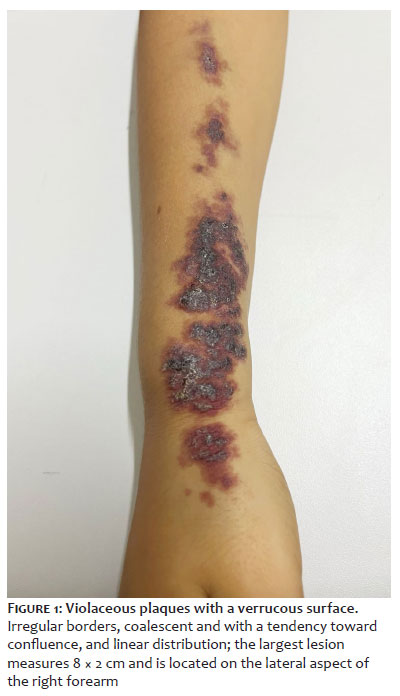
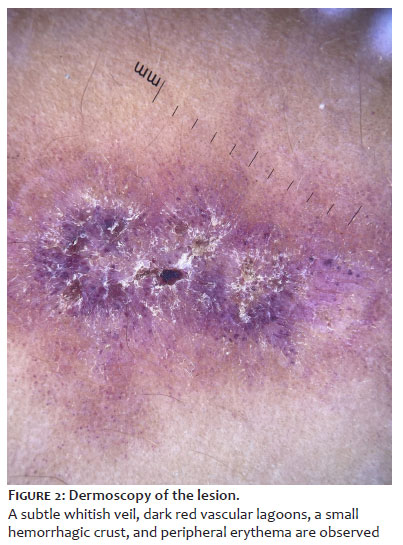
Dermatological examination revealed violaceous plaques with a verrucous surface, irregular borders, coalescent, and with a tendency toward confluence, and a linear distribution, the largest measuring 8 × 2 cm on the lateral aspect of the right forearm (Figure 1). Dermoscopy revealed a subtle whitish veil, dark red vascular lagoons, a small hemorrhagic crust, and peripheral erythema (Figure 2).
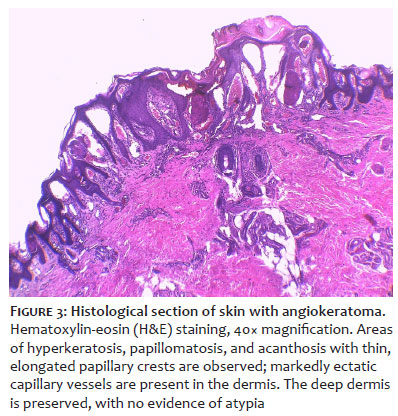
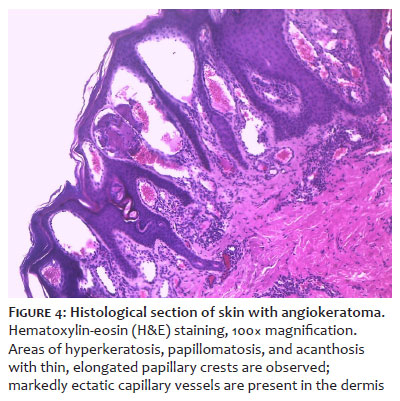
A biopsy of the lesion was performed, revealing an epidermis with areas of hyperkeratosis and papillomatosis, associated with markedly ectatic capillary vessels in the dermis, lined by flattened endothelium and congested with erythrocytes (Figures 3 and 4).
Based on clinical and histopathological findings, a diagnosis of angiokeratoma circumscriptum was established, and initial treatment with cryotherapy was indicated.
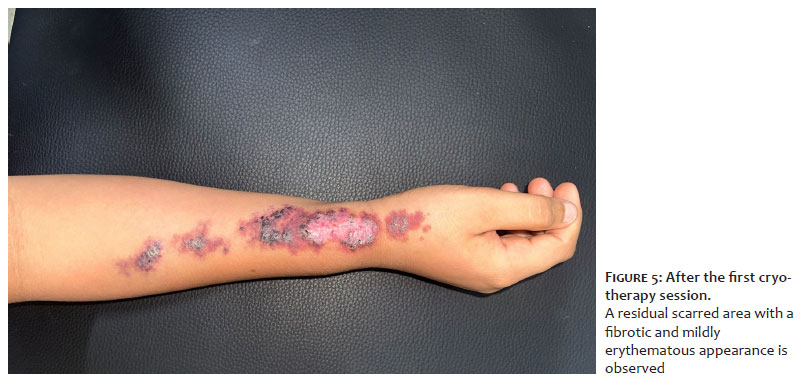
For cryotherapy, local infiltration anesthesia was performed using 2% lidocaine diluted in 0.9% saline. The procedure consisted of two freezing cycles of 30 seconds each, interspersed with spontaneous thawing periods of approximately 2 minutes, encompassing the lower third of the largest lesion. Following healing, a residual scarred area with a fibrotic and mildly erythematous appearance was observed (Figure 5), and both the patient and his legal guardian reported a high degree of satisfaction.
Given the favorable therapeutic response, additional sessions were scheduled, during which small areas of the lesion were treated gradually in order to minimize procedural pain. Treatment resulted in a substantial reduction in recurrent bleeding episodes, providing the patient with greater freedom to perform daily activities
Angiokeratoma is a rare vascular malformation of still incompletely understood etiology, with an estimated prevalence of approximately 0.16% in the general population.1,2 According to the literature, the circumscriptum subtype accounts for approximately 13% of cases, predominantly affecting females and preferentially involving the distal segments of the lower limbs.1,3,5 In contrast, the present report describes a young male patient with involvement of an upper limb, representing an atypical clinical presentation.4-6
Angiokeratoma circumscriptum is clinically characterized by erythematous-violaceous, verrucous, and hyperkeratotic plaques that are generally asymptomatic; however, episodes of bleeding following trauma may occur in approximately 25% of cases.1,2,5 Although most cases are observed at birth, there have also been reports of late development during childhood or adolescence.2,4,6
Diagnosis is predominantly clinical, aided by dermoscopy and confirmed by histopathological examination.1,2,5 The main differential diagnosis is verrucous hemangioma, which differs from angiokeratoma by exhibiting vascular ectasia involving not only the epidermis but also the dermis and hypodermis.1,3,5 Other differential diagnoses include malignant melanoma, Spitz nevus, deep mycoses, and viral warts.1,2,5
The main indications for treatment of angiokeratoma circumscriptum are recurrent bleeding and aesthetic discomfort.1,3,7 Therapeutic options include cryotherapy, surgical excision, and curettage associated with electrocautery for smaller lesions.1,7,8 For more extensive lesions, laser ablation is preferred in order to reduce the risk of substantial disfigurement.1,5,8
Cryosurgery consists of the application of liquid nitrogen, using either a spray device or a cotton-tipped dipstick, promoting cellular destruction through freezing.8,9 Liquid nitrogen has an approximate temperature of −195 °C, resulting in tissue temperatures between −50 °C and −60 °C, which are considered ideal for cellular destruction.9 It is a quick, simple, low-cost, and widely available technique.8,9
In the present case, therapeutic intervention was chosen because of the frequent episodes of bleeding following minor trauma.1,3 Cryotherapy was selected based on lesion size, the availability of the technique at the service, and patient cooperation,7-9 providing progressively satisfactory results throughout the treatment sessions. Although complete remission of the lesion was not achieved, there was a substantial reduction in the frequency of bleeding episodes, with a consequent improvement in the patient’s quality of life
Angiokeratoma circumscriptum is a rare vascular malformation with variable clinical presentations. This report describes a case with atypical features in which cryotherapy proved to be a safe and effective therapeutic alternative, promoting bleeding control and functional improvement, with a positive impact on the patient’s quality of life. Therefore, cryotherapy may be considered a viable and minimally invasive option for the management of selected cases of angiokeratoma circumscriptum.
Malu de Aquino Almeida Garcia
ORCID: 0009-0003-7107-2888
Approval of the final version of the manuscript, Critical review of the literature, Acquisition, analysis and interpretation of data, Intellectual participation in the propaedeutic and/or therapeutic approach to the cases studied, Critical revision of the manuscript, Preparation and writing of the manuscript, Statistical analysis, Conception and design of the study
Louise Santos Abdulmassih
ORCID: 0009-0006-3221-913X
Approval of the final version of the manuscript, Critical review of the literature, Acquisition, analysis and interpretation of data, Intellectual participation in the propaedeutic and/or therapeutic approach to the cases studied, Critical revision of the manuscript, Statistical analysis, Conception and design of the study
Maria Amelia Lopes dos Santos
ORCID: 0000-0001-8606-6948
Critical review of the literature, Effective participation in the conduct of the study, Intellectual participation in the propaedeutic and/or therapeutic approach to the cases studied, Critical revision of the manuscript, Statistical analysis, Conception and design of the study - Universidade do Estado do Pará (UEPA), Dermatology Service, Belém (PA), Brazil
Renata Mie Oyama Okajima
ORCID: 0000-0003-2168-5515
Approval of the final version of the manuscript, Critical review of the literature, Intellectual participation in the propaedeutic and/or therapeutic approach to the cases studied, Critical revision of the manuscript, Statistical analysis, Conception and design of the study
Josie Eiras Bisi dos Santos
ORCID: 0000-0001-8512-3920
Acquisition, analysis and interpretation of data, Intellectual participation in the propaedeutic and/or therapeutic approach to the cases studied, Critical revision of the manuscript, Preparation and writing of the manuscript, Statistical analysis
1. Papaiordanou F, Loda G, Benez M, Quintella L. Angioqueratoma circunscrito: clínica, dermatoscopia e tratamento cirúrgico. Surg Cosmet Dermatol. 2020;12(1):70-3.
2. Ivy H, Julian CA. Angiokeratoma circumscriptum [Internet]. In: StatPearls. Treasure Island (FL): StatPearls Publishing; 2025 [citado 6 jan 2025]. Disponível em: https://www.ncbi.nlm.nih.gov/books/NBK549769/
3. Massucatti K, Villa RT, Bedin V. Angioqueratoma circunscrito: uma entidade subdiagnosticada. Med Cutan Ibero Lat Am. 2011;39(1):19-22.
4. Grewal AK, Chambers CJ, Silverstein M. Relato de caso de múltiplos angioqueratomas de início na idade adulta com distribuição zosteriforme. Dermatol Online J. 2018;24(10):13030/qt9644290r.
5. Guillen-Climent S, García-Vázquez A, Silva Díaz E, Pinazo I. Angiokeratoma circumscriptum. Dermatol Online J. 2020;26(11).
6. Yunoki M, Kondo S, Otsuka M, Tokura Y. Angioqueratoma circunscrito adquirido com configuração em aranha e regressão espontânea. JAAD Case Rep. 2025;63:84-6.
7. Bayraktar N. Angioqueratoma de Fordyce: comparação entre crioterapia e eletrocauterização. Dermatol Res Pract. 2022;2022:2223602.
8. Yang S, Kampp J. Procedimentos dermatológicos comuns. Med Clin North Am. 2015;99(6):1305-21.
9. Prohaska J, Jan AH. Crioterapia em dermatologia [Internet]. In: StatPearls. Treasure Island (FL): StatPearls Publishing; 2025 [atualizado 15 set 2023].
 All content the journal, except where identified, under the Creative Commons Attribution 4.0 International licence - ISSN-e 1984-8773




 Read in Portuguese
 Portuguese PDF
 Print
Print
 Send this article by email
 How to cite this article
 Submit a comment
 Mendeley
 Pocket
 Share on Facebook
 Share on Twitter