


Ana Vitoria Lins de Paiva Antunes; Clarissa Brito de Farias; Luciana Cavalcanti Trindade; Renata Monteiro de Lacerda
Funding source: None
Conflict of interest: None
Submitted on: 11/09/2025
Final decision: 03/22/2026
How to cite this article: Antunes AVLP, Farias CB, Trindade LC, Lacerda RM. Therapeutic refractoriness of multiple pyogenic granulomas on nail folds as an adverse effect of amivantamab: a case report. Surg Cosmet Dermatol. 2026;18(2):e20260538.
Amivantamab is a bispecific anti-EGFR and anti-MET monoclonal antibody indicated for non-small cell lung cancer harboring EGFR exon 20 insertion mutations. Although effective, it may cause cutaneous adverse events such as paronychia and pyogenic granulomas. We report a case of periungual pyogenic granuloma in a patient undergoing amivantamab therapy, emphasizing the causal relationship, clinical evolution, and surgical management. Early recognition and a multidisciplinary approach are crucial to maintain oncological treatment while ensuring adequate control of dermatologic manifestations.
Keywords: Granuloma, Pyogenic. Drug-Related Side Effects and Adverse Reactions; Molecular Targeted Therapy
Amivantamab is a fully human immunoglobulin G1 (IgG1)-based bispecific monoclonal antibody produced in a mammalian cell line using recombinant DNA technology.¹ As monotherapy or in combination with other agents, it is indicated for the treatment of adults with metastatic or inoperable non-small cell lung cancer (NSCLC).²
The drug received accelerated Food and Drug Administration (FDA) approval in May 2021, demonstrating a substantial overall response rate and durable responses.¹ However, adverse events may occur in patients receiving amivantamab, including infusion-related reactions, skin rashes, paronychia, musculoskeletal pain, dyspnea, nausea, and fatigue.²
Cutaneous adverse events are common and are characterized by acneiform eruptions, xerosis, fissures, nail changes, and periungual inflammatory lesions. Pyogenic granuloma is a relevant lesion in this context, as it may arise from the progression of chronic paronychia, an inflammation of the nail folds frequently observed during amivantamab therapy. These effects are attributed to chronic inflammatory processes and impairment of skin integrity.7,10
Pyogenic granulomas are benign vascular proliferations of the skin or subcutaneous tissue.³ The development of these lesions is associated with triggering factors such as trauma, infection, foreign-body reactions, delayed wound healing, and, in cases of multiple lesions, the use of oncologic medications. Although multiple therapeutic options are available for this type of lesion, persistence of the causal factor results in refractoriness.4
Given the above, this study aims to demonstrate the persistence of periungual manifestations as an adverse effect of amivantamab therapy despite multiple therapeutic interventions.
A 45-year-old female patient was diagnosed with a pulmonary malignancy with brain metastases in May 2023. Amivantamab was initiated in October of the same year because the neoplasm was inoperable and metastatic. She presented for dermatologic evaluation in June 2024 due to the onset of lesions affecting the fingernails and toenails that had been present for 6 months.
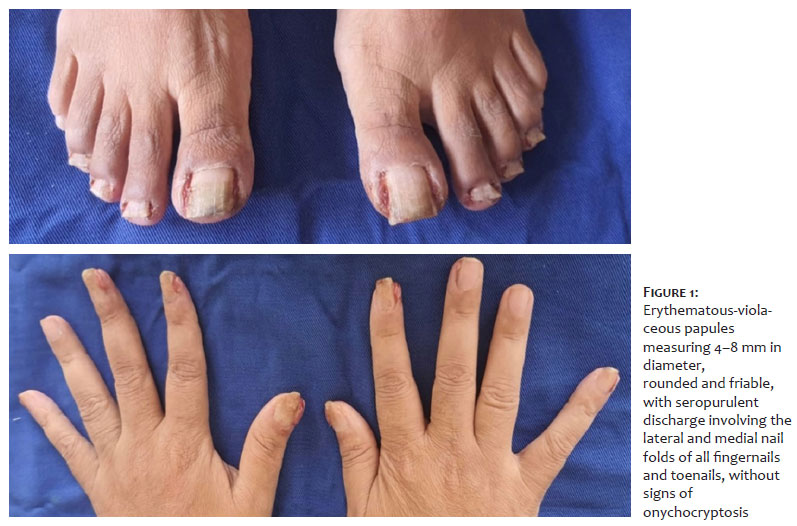
Physical examination revealed erythematous-violaceous papules measuring 4–8 mm in diameter, rounded and friable, with seropurulent discharge involving the lateral and medial nail folds of all fingernails and toenails, without signs of onychocryptosis, consistent with paronychia and pyogenic granuloma (Figure 1).
Given this diagnosis, treatment was initiated with cefadroxil, trimethoprim-sulfamethoxazole, and amoxicillin-clavulanate. In addition, topical treatments with 65% nitric acid, 50% trichloroacetic acid (TCA), liquid nitrogen cryosurgery, topical timolol, and silver nitrate were administered. These therapies resulted in temporary improvement of the infectious process but failed to induce regression of the lesions, thus characterizing the condition as an adverse effect of systemic amivantamab therapy.
The persistence of the lesions despite treatment led to the decision to initiate an off-label therapy for lesions such as those observed in this patient, which has shown promising results in similar cases: low-dose oral isotretinoin. However, this treatment was contraindicated by the medical oncologist because the patient had hepatic metastases
Amivantamab is a bispecific monoclonal antibody designed to simultaneously target the epidermal growth factor receptor (EGFR) and the mesenchymal-epithelial transition factor receptor (MET), representing a major therapeutic advance in the management of NSCLC.1,3 The EGFR exon 20 insertion mutation confers resistance to conventional tyrosine kinase inhibitors, which is why amivantamab monotherapy was approved for use in adult patients with advanced disease after treatment failure.2,5 Despite promising results in terms of efficacy and durability of response, the safety profile and adverse events associated with this therapy are still undergoing more comprehensive characterization in real-world clinical settings.3
Among the reported adverse events are infusion-related reactions, skin conditions, infections, and respiratory complications.2,3 Cutaneous manifestations are particularly frequent and include acneiform eruptions, xerosis, fissures, and paronychia, the latter frequently accompanied by the development of pyogenic granulomas (PGs).3,6 Paronychia induced by anti-EGFR therapies results from chronic inflammation of the nail folds, leading to disruption of the skin barrier and favoring secondary vascular proliferative processes.4
PG is a benign reactive vascular tumor that may occur at any age and typically presents clinically as a rapidly growing erythematous nodular lesion with a lobulated surface and a tendency to bleed.4,7 In recent years, there has been a marked increase in the occurrence of PGs associated with targeted antineoplastic therapies, particularly those that inhibit the EGFR pathway, such as amivantamab.6,7 Inhibition of this pathway promotes changes in epidermal repair and inflammatory mechanisms, predisposing patients to the development of multiple recurrent periungual lesions.7
Therapeutic management of these lesions requires an individualized approach that takes into account both local control of the granuloma and maintenance of anticancer therapy.4 Treatment options include topical or systemic agents, chemical cauterization with silver nitrate, cryosurgery, laser therapy, sclerotherapy, and surgical procedures.4,8 Surgical excision is considered the gold standard because of its lower recurrence rate, although less invasive interventions are preferred in cases involving multiple lesions or impaired wound healing.8 More recently, topical beta-blockers such as timolol and betaxolol have emerged as promising alternatives for the treatment of PGs associated with EGFR inhibitors, possibly through modulation of angiogenesis and reduction of local blood flow.9,10
Despite the various therapeutic options available, continued exposure to the causal agent—in this case, amivantamab—represents an important therapeutic challenge.3,6 Discontinuing the medication is rarely feasible because of its essential role in tumor control, which limits complete resolution of the skin lesions. Therefore, management should prioritize a balance between continuation of anticancer treatment and control of dermatologic manifestations, through a multidisciplinary approach involving both oncologists and dermatologists. This integration is essential to optimize treatment adherence, minimize the impact on quality of life, and contribute to the safer use of emerging targeted therapies.
Ana Vitoria Lins de Paiva Antunes
ORCID: 0000-0002-5171-245X
Conception and design of the study, Preparation and writing of the manuscript, Intellectual participation in the propaedeutic and/or therapeutic approach to the cases studied, Critical review of the literature, Critical revision of the manuscript.
Clarissa Brito de Farias
ORCID: 0009-0009-5395-045X
Acquisition, analysis and interpretation of data, Intellectual participation in the propaedeutic and/or therapeutic approach to the cases studied, Critical review of the literature.
Luciana Cavalcanti Trindade
ORCID: 0000-0002-0643-1093
Effective participation in the conduct of the study, Critical review of the literature, Critical revision of the manuscript.
Renata Monteiro de Lacerda
ORCID: 0000-0003-4661-3745
Approval of the final version of the manuscript, Conception and design of the study, Effective participation in the conduct of the study, Critical revision of the manuscript.
1. Neijssen J, Cardoso RMF, Chevalier KM, Wiegman L, Valerius T, Anderson GM, et al. Discovery of amivantamab (JNJ-61186372), a bispecific antibody targeting EGFR and MET. J Biol Chem. 2021;296:100641.
2. Vijayaraghavan S, Lipfert L, Chevalier K, Bushey BS, Henley B, Lenhart R, et al. Amivantamab (JNJ-61186372), an Fc Enhanced EGFR/cMet Bispecific Antibody, Induces Receptor Downmodulation and Antitumor Activity by Monocyte/Macrophage Trogocytosis. Mol Cancer Ther. 2020;19(10):2044-56.
3. Zhang J, Li W. Real-world pharmacovigilance analysis unveils the toxicity profile of amivantamab targeting EGFR exon 20 insertion mutations in non-small cell lung cancer. BMC Pulm Med. 2025;25(1):63.
4. Wollina U, Langner D, França K, Gianfaldoni S, Lotti T, Tchernev G. Pyogenic Granuloma – A Common Benign Vascular Tumor with Variable Clinical Presentation: New Findings and Treatment Options. Open Access Maced J Med Sci. 2017;5(4):423-6.
5. Moores SL, Laquerre S, Lorenzi MV. The user’s guide to amivantamab: A bispecific EGFR-MET antibody in EGFR exon 20 insertion-mutated NSCLC. Curr Treat Options Oncol. 2025;26(2):67.
6. Harrington S, Straka J, Aguh C. Erosive pustular dermatosis–like eruption of the scalp from amivantamab: A series of 3 cases. JAAD Case Rep. 2024;52:116-9.
7. Lim SY, Seet JE, Wong EPY, Chow PKH. Pyogenic granuloma as a dermatological adverse event induced by epidermal growth factor receptor inhibitors. Oncologist. 2025;30(1):36-44.
8. Lee EJ, Park JH, Kim JW. Nd:YAG laser versus sclerotherapy for treatment of pyogenic granuloma in children: a retrospective study. Sci Rep. 2025;15:1021.
9. Chen Y, Pradhan S, Xue S. Topical brimonidine for pyogenic granuloma after paronychia surgery. JAAD Case Rep. 2020;7:41-3.
10. Fabbrocini G, Marasca C, Ruggiero A, Cacciapuoti S. Topical betaxolol for the treatment of paronychia and granulation tissue-like lesions induced by epidermal growth factor receptor inhibitors. J Eur Acad Dermatol Venereol. 2021;35(6):e403-5.
 All content the journal, except where identified, under the Creative Commons Attribution 4.0 International licence - ISSN-e 1984-8773




 Read in Portuguese
 Portuguese PDF
 Print
Print
 Send this article by email
 How to cite this article
 Submit a comment
 Mendeley
 Pocket
 Share on Facebook
 Share on Twitter